
How to Start a Sober Living Home: Complete 2026 Guide for Operators
Step-by-step guide to starting a sober living home in 2026. Learn startup costs ($50K-150K), revenue potential ($1,500-3,500/bed), licensing by state, and how to reach profitability in 6-18 months.
Legal Disclaimer
This article is for informational purposes only and does not constitute legal, financial, or compliance advice. Regulations vary by jurisdiction and change frequently. Consult qualified professionals for specific guidance on compliance requirements in your state.
How to Start a Sober Living Home: Complete 2026 Guide
Important: This guide provides general information for educational purposes only. It is not legal, financial, or compliance advice. Recovery housing regulations vary by state, county, and municipality. You must consult with a qualified local attorney and your municipality’s code enforcement office to confirm all requirements at every level of jurisdiction before opening a sober living home. Regulations change frequently — always verify current requirements directly with relevant government agencies.
The recovery housing industry is experiencing unprecedented demand. With over 46 million Americans struggling with substance use disorders and treatment center capacity stretched thin, sober living homes have become essential bridges between clinical treatment and independent living. For entrepreneurs, healthcare professionals, and people in recovery looking to give back, opening a sober living home represents both a meaningful mission and a viable business opportunity.
This comprehensive guide walks you through every step of starting a sober living home in 2026, from evaluating profitability to opening your doors to residents. Whether you are planning your first home or expanding an existing operation, you will find the practical information you need to succeed.
Is Starting a Sober Living Home Profitable?
Before diving into the operational details, let us address the question most prospective operators ask first: Can you actually make money running a sober living home?
The short answer is yes. The longer answer requires understanding the economics of recovery housing.
Revenue Potential by Market
Sober living homes generate revenue primarily through resident fees, which vary significantly by location, amenities, and level of support provided.
| Market Type | Weekly Rate | Monthly Rate | Per Bed Annually |
|---|---|---|---|
| Budget/Rural | $100-$150 | $400-$600 | $4,800-$7,200 |
| Mid-Market | $150-$250 | $600-$1,000 | $7,200-$12,000 |
| Urban/Suburban | $200-$350 | $800-$1,400 | $9,600-$16,800 |
| Premium/Luxury | $350-$600 | $1,400-$2,400 | $16,800-$28,800 |
| Executive/Specialty | $600-$1,000+ | $2,400-$4,000+ | $28,800-$48,000+ |
Profit Margin Analysis
Well-managed sober living homes typically achieve profit margins of 20-35% after all expenses. Here is how the numbers work for a standard 10-bed operation:
Mid-Market 10-Bed Example ($225/week average)
| Category | Monthly | Annual |
|---|---|---|
| Gross Revenue (85% occupancy) | $8,288 | $99,450 |
| Rent/Mortgage | $2,500 | $30,000 |
| Utilities | $600 | $7,200 |
| Insurance | $400 | $4,800 |
| Staff Costs | $2,000 | $24,000 |
| Supplies/Maintenance | $500 | $6,000 |
| Software/Technology | $200 | $2,400 |
| Marketing | $300 | $3,600 |
| Miscellaneous | $400 | $4,800 |
| Total Expenses | $6,900 | $82,800 |
| Net Profit | $1,388 | $16,650 |
| Profit Margin | 16.7% |
Premium 10-Bed Example ($400/week average)
| Category | Monthly | Annual |
|---|---|---|
| Gross Revenue (85% occupancy) | $14,733 | $176,800 |
| Rent/Mortgage | $4,500 | $54,000 |
| Utilities | $800 | $9,600 |
| Insurance | $600 | $7,200 |
| Staff Costs | $4,000 | $48,000 |
| Supplies/Maintenance | $800 | $9,600 |
| Software/Technology | $300 | $3,600 |
| Marketing | $500 | $6,000 |
| Miscellaneous | $600 | $7,200 |
| Total Expenses | $12,100 | $145,200 |
| Net Profit | $2,633 | $31,600 |
| Profit Margin | 17.9% |
ROI Timeline
Most sober living homes reach profitability within 6-18 months, depending on several factors:
Faster Path to Profitability (6-12 months)
- Starting with leased property versus purchasing
- Operating in high-demand markets
- Strong referral relationships with treatment centers
- Experienced operator or house manager
- Lower renovation requirements
Slower Path to Profitability (12-18+ months)
- Property purchase with mortgage
- New market without established referral network
- Significant renovation requirements
- First-time operator learning curve
- Seasonal markets with occupancy fluctuations
What Successful Operators Say
“I started with one 8-bed house in 2019 with about $75,000 in startup capital. We hit profitability in month 8 and broke even on our initial investment by month 14. Five years later, I operate 6 homes with 52 beds generating over $800,000 annually. The key was building strong relationships with local treatment centers and maintaining high quality standards.”
- Recovery housing operator, Arizona
“The margins are real, but they require discipline. Our first year we barely broke even because we underpriced and overspent on renovations. Year two we raised rates, tightened operations, and made a 28% margin. Now we target 25-30% across our portfolio.”
- Multi-site operator, Texas
Step 1: Understand State Requirements
One of the most common questions from prospective operators is whether you need a license to open a sober living home. The answer depends entirely on your state.
States Requiring Licensure or Certification
Several states have mandatory licensing or certification requirements for sober living homes:
California
- Alcohol and Drug Program (ADP) certification required for homes accepting referrals from licensed treatment programs
- Compliance with California Health and Safety Code
- See our California sober living guide for details
Florida
- FARR (Florida Association of Recovery Residences) certification required for treatment center referrals
- Florida Statute 397.487 compliance
- See our Florida sober living guide for details
Massachusetts
- MASH (Massachusetts Alliance for Sober Housing) certification available
- Operators working with state-funded programs need certification
- See our Massachusetts NARR affiliate guide
New Jersey
- State licensure requirements for some recovery residences
- NJ Alliance for Recovery Residences (NJARR) certification
- See our New Jersey NARR affiliate guide
Pennsylvania
- PARR (Pennsylvania Alliance of Recovery Residences) certification
- State licensure for certain facility types
- See our Pennsylvania NARR affiliate guide
States with Voluntary Certification
Most states operate on a voluntary certification model through NARR (National Alliance for Recovery Residences) affiliate organizations:
| State | NARR Affiliate | Certification |
|---|---|---|
| Arizona | AZARR | Voluntary |
| Colorado | CARR | Voluntary |
| Georgia | GARR | Voluntary |
| Illinois | ILARR | Voluntary |
| Kentucky | KYARR | Voluntary |
| Michigan | MARR | Voluntary |
| North Carolina | NCARR | Voluntary |
| Ohio | ORR | Voluntary |
| Texas | TARR | Voluntary |
| Washington | WARR | Voluntary |
While certification may be voluntary in these states, it provides significant advantages:
- Credibility with treatment centers and referral sources
- Access to state and federal funding programs
- Protection against nuisance lawsuits
- Inclusion in insurance networks
- Quality standards and best practices support
States with Minimal or No Requirements
Some states have few formal requirements for sober living homes at the state level:
- Alabama
- Alaska
- Arkansas
- Idaho
- Mississippi
- Montana
- Nevada
- New Hampshire
- North Dakota
- South Dakota
- Wyoming
However, cities and counties may have their own group home, boarding home, or other local ordinances that impose additional requirements. You must verify all local regulations with your municipality and consult a qualified local attorney before beginning operations.
Even in these states, you should still comply with:
- Fair Housing Act requirements
- Local zoning ordinances
- Building and fire safety codes
- Business registration requirements
Understanding NARR Certification Levels
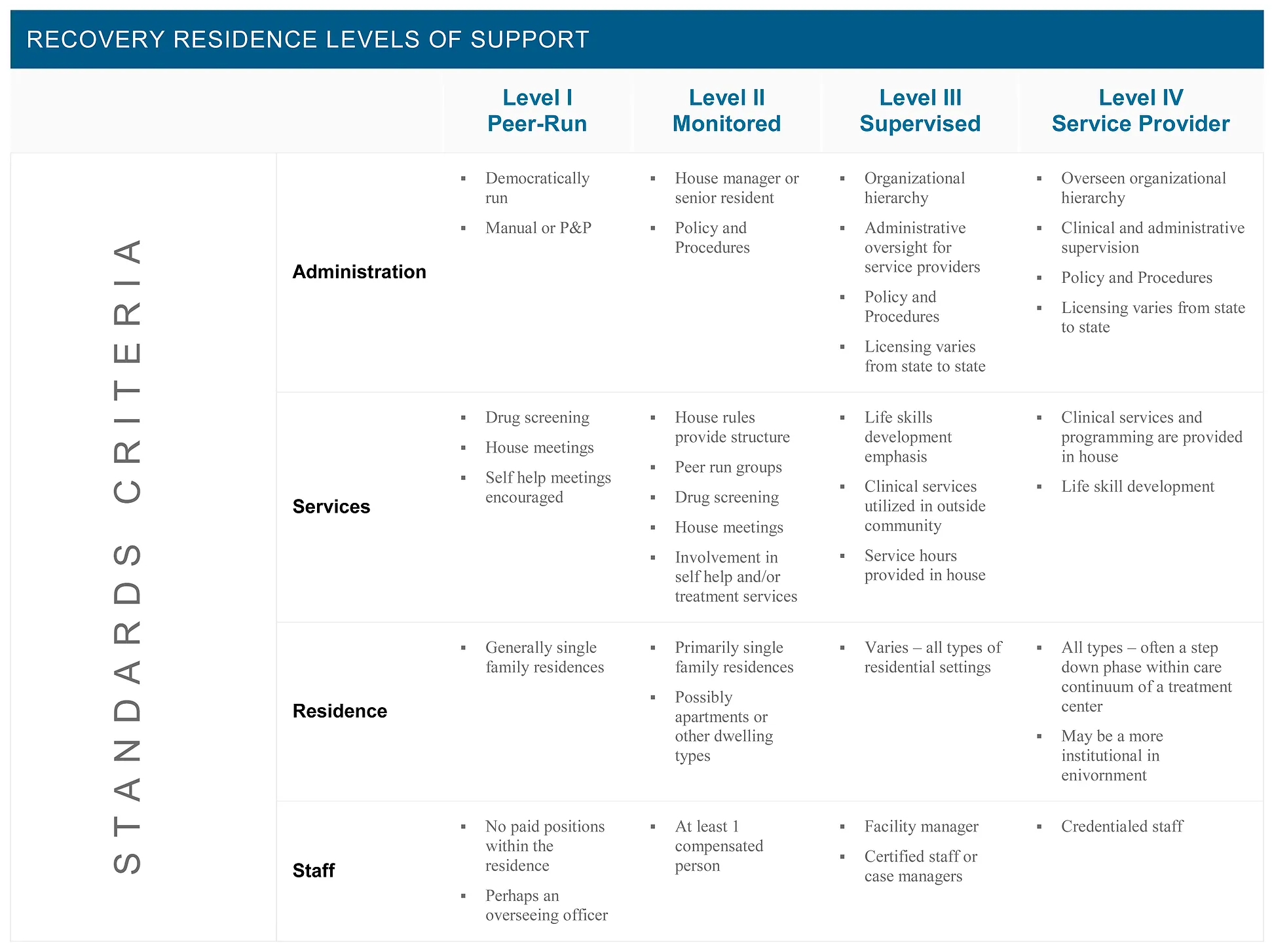
The National Alliance for Recovery Residences has established four levels of support, which most state affiliates have adopted:
Level 1: Peer-Run
- Democratically run household
- Minimal structure and oversight
- Residents manage house operations
- No paid staff required
- Lowest barrier to entry
Level 2: Monitored
- House manager provides oversight
- More structure and accountability
- Regular drug testing
- Required house meetings
- Most common certification level
Level 3: Supervised
- Higher staff-to-resident ratios
- Clinical services available
- Structured programming
- Often connected to treatment providers
- Higher operating costs
Level 4: Service Provider
- Licensed clinical staff on-site
- Comprehensive treatment services
- Highest level of structure
- Most expensive to operate
- May require healthcare licensing
Most new operators start at Level 1 or Level 2, which have lower startup costs and simpler compliance requirements.
Step 2: Choose Your Business Model
Before investing in property or applying for certification, you need to clarify exactly what type of sober living home you want to operate. Your business model will affect everything from startup costs to resident demographics to referral sources.
NARR Level Comparison for Operators
| Factor | Level 1 | Level 2 | Level 3 | Level 4 |
|---|---|---|---|---|
| Startup Cost | $25K-$50K | $50K-$100K | $100K-$250K | $250K+ |
| Staff Required | None (peer-run) | House manager | Manager + staff | Clinical team |
| Revenue/Bed | $400-$800/mo | $600-$1,200/mo | $1,000-$2,000/mo | $2,000-$4,000/mo |
| Operating Margin | 15-25% | 20-30% | 20-35% | 25-40% |
| Complexity | Low | Moderate | High | Very High |
| Best For | First-time operators | Most operators | Experienced operators | Healthcare providers |
MAT-Friendly vs. Traditional
One of the most important business decisions is whether to accept residents on Medication-Assisted Treatment (MAT):
MAT-Friendly Homes
- Accept residents on buprenorphine (Suboxone), methadone, or naltrexone (Vivitrol)
- Growing demand as MAT becomes standard of care
- Higher occupancy rates in many markets
- May require medication storage and management protocols
- Some referral sources specifically seek MAT-friendly homes
- Read our guide on MAT and sober living compatibility
Traditional (Abstinence-Only) Homes
- No MAT medications permitted
- Appeals to 12-step focused residents
- Simpler medication management
- May limit referral sources
- Declining market share in many areas
Our Recommendation: Consider being MAT-friendly. The evidence strongly supports MAT for opioid use disorder, and limiting your resident pool increasingly means limiting your revenue potential. Many successful operators accept MAT while maintaining high recovery standards.
Population Focus
Your target population affects marketing, property requirements, and operations:
Men’s Homes
- Largest market segment
- Often higher occupancy rates
- May accommodate more residents per property
- Lower bathroom-to-resident ratio needs
- Generally higher property wear
Women’s Homes
- Growing demand, often underserved
- May require childcare considerations
- Higher bathroom requirements
- Often command premium pricing
- Strong referral networks from women’s treatment programs
Co-Ed Homes
- Less common due to management complexity
- Requires careful policy development
- May fill beds faster in thin markets
- Higher risk of relationship issues
- Can work well with proper structure
Specialty Populations
- LGBTQ+ focused homes
- Young adult (18-25) specific homes
- Veterans-focused recovery housing
- Professional/executive recovery
- First responder specific homes
Specialty homes can command premium pricing and face less competition, but require deeper understanding of population-specific needs.
Oxford House vs. Traditional Model
The Oxford House model represents a specific approach to recovery housing:
Oxford House Characteristics
- Democratically self-run
- No paid staff or management
- Residents pay equal shares of expenses
- New residents voted in by current residents
- Discharge requires house vote
- National charter and network
Traditional Model Characteristics
- Owner/operator managed
- Paid house manager
- Owner sets policies and pricing
- Owner makes admission decisions
- More control but more responsibility
- Independent or small network operations
Most operators choose the traditional model because it provides greater control over operations, pricing, and quality. Oxford Houses are valuable additions to the recovery ecosystem but represent a different business model.
Step 3: Secure Funding
Starting a sober living home requires capital. Here is a realistic breakdown of what you will need and how to get it.
Startup Cost Breakdown
Minimum Viable Operation: $50,000-$75,000
| Expense | Range |
|---|---|
| First/last month rent + security deposit | $6,000-$15,000 |
| Basic furnishing (beds, furniture, supplies) | $5,000-$10,000 |
| Minor renovations and repairs | $5,000-$15,000 |
| Licensing and certification fees | $1,000-$3,000 |
| Insurance (first year) | $3,000-$8,000 |
| Legal and accounting setup | $2,000-$5,000 |
| Marketing and website | $1,000-$3,000 |
| Operating capital (3-6 months) | $15,000-$30,000 |
| Technology and software | $500-$2,000 |
| Drug testing supplies | $500-$1,500 |
| Total | $39,000-$92,500 |
Standard Operation: $100,000-$150,000
This budget allows for:
- Better property in stronger location
- More comprehensive renovations
- Higher quality furnishings
- 6-month operating reserve
- Professional marketing
- Full certification and compliance
Premium Operation: $150,000-$300,000+
This budget supports:
- Property purchase or premium lease
- Extensive renovations
- High-end furnishings and amenities
- 12-month operating reserve
- Multiple staff members
- Comprehensive marketing campaign
Funding Sources
Personal Investment Most sober living operators fund at least part of their startup personally. This demonstrates commitment to lenders and partners.
SBA Loans Small Business Administration loans offer favorable terms for qualified borrowers:
- SBA 7(a) loans up to $5 million
- SBA Microloans up to $50,000
- Longer repayment terms than conventional loans
- Requires business plan and collateral
CDFI Loans Community Development Financial Institutions specialize in underserved communities and social enterprises:
- More flexible underwriting than traditional banks
- Often support recovery housing as community development
- May offer technical assistance alongside funding
- Lower interest rates than alternative lenders
Private Investors Some operators partner with investors who provide capital in exchange for equity or preferred returns:
- Faster access to capital
- May include operational expertise
- Dilutes ownership and control
- Requires legal structure
Grant Opportunities While grants are competitive, several sources support recovery housing:
- SAMHSA Recovery Housing Program
- State opioid settlement funds
- HUD Continuum of Care Program
- Private foundations
- See our complete grants for recovery homes guide
Home Equity If you own property, a home equity line of credit can provide startup capital:
- Lower interest rates than unsecured loans
- Flexible draw and repayment
- Risk to personal residence
- Requires sufficient equity
Financial Projections for Lenders
If seeking loans or investment, you will need financial projections. Here is what lenders want to see:
Year 1 Projections (Conservative)
- Occupancy ramp: 50% months 1-3, 70% months 4-6, 80%+ months 7-12
- Revenue growth as occupancy builds
- Operating costs relatively fixed
- Break-even typically months 8-12
Year 2-3 Projections
- Stabilized occupancy at 85%+
- Modest rate increases (3-5% annually)
- Operating leverage as fixed costs spread
- Profit margins of 20-30%
5-Year Model
- Expansion possibilities
- Multiple property scenarios
- Management company structure
- Exit strategy options
Step 4: Find the Right Property
Property selection is critical to sober living success. The wrong property can doom your operation before it starts.
Zoning Requirements
Fair Housing Act Protections Sober living homes are protected under the Fair Housing Act as housing for people with disabilities. This means:
- Generally cannot be excluded from residential zones through discriminatory ordinances
- Cannot be treated differently from other group living arrangements
- Reasonable accommodations must be made
- Operators have legal recourse against discriminatory enforcement
However, Fair Housing Does Not Override:
- Legitimate building and fire codes
- Reasonable occupancy limits based on square footage
- Parking requirements applied uniformly
- Public health and safety regulations
Zoning Due Diligence Checklist Before signing a lease or purchasing property:
- Review local zoning code for group home provisions
- Check for distance/spacing requirements from other recovery homes
- Verify occupancy limits based on bedrooms and bathrooms
- Confirm parking requirements (typically 1 space per 2-3 residents)
- Research any conditional use permit requirements
- Consult with attorney experienced in Fair Housing issues
- Contact NARR affiliate for guidance on local regulations
Property Requirements by NARR Level
Level 1-2 Requirements
- Minimum 70 square feet per resident in sleeping areas
- 1 bathroom per 6 residents minimum (1 per 4 preferred)
- Common living and dining areas
- Functioning kitchen facilities
- Smoke detectors on every floor
- Fire extinguisher accessible
- Safe, well-maintained property
- Adequate parking
Level 3-4 Additional Requirements
- Private or semi-private bedrooms
- Office space for staff
- Meeting/group room
- Medication storage area
- ADA accessibility features
- Enhanced safety systems
- Larger common areas
Lease vs. Purchase Analysis
| Factor | Leasing | Purchasing |
|---|---|---|
| Upfront Capital | Lower | Higher |
| Monthly Cost | Higher | Lower (long-term) |
| Flexibility | Higher | Lower |
| Control | Limited | Full |
| Building Equity | No | Yes |
| Renovation Freedom | Restricted | Full |
| Exit Strategy | Easier | More complex |
| Best For | New operators, testing markets | Established operators, long-term commitment |
Leasing Considerations
- Look for 3-5 year leases with renewal options
- Negotiate landlord permission for recovery housing use in writing
- Understand landlord’s renovation restrictions
- Consider rent escalation clauses
- Build relationship with landlord
Purchasing Considerations
- Require professional inspection
- Confirm financing before making offers
- Budget 10-20% for closing costs and immediate repairs
- Consider property management needs
- Plan for capital improvements
Property Evaluation Checklist
Location Factors
- Proximity to treatment centers (referral sources)
- Access to public transportation
- Walking distance to employment opportunities
- Safe neighborhood with low crime rates
- Access to 12-step meetings and recovery community
- Distance from high-risk areas (bars, drug activity)
- Grocery stores and essential services nearby
Property Features
- Adequate bedrooms (4-6 ideal for single-family home)
- Sufficient bathrooms (1 per 4-6 residents)
- Functional kitchen for multiple users
- Common living area for house meetings
- Laundry facilities (on-site preferred)
- Outdoor space (yard, patio, or deck)
- Storage for resident belongings
- Adequate parking
Condition Assessment
- Roof condition and remaining life
- HVAC system functionality and age
- Plumbing condition (especially with multiple bathrooms)
- Electrical system capacity
- Foundation and structural integrity
- Evidence of water damage or mold
- Fire safety features (detectors, exits)
- ADA accessibility or modification potential
Step 5: Create Policies and Procedures
Clear policies protect your residents, your staff, and your business. Every sober living home needs comprehensive written documentation.
Essential Policy Documents
House Rules Your house rules establish the structure that supports recovery:
- Zero tolerance for substance use (define what constitutes use)
- Drug testing requirements (frequency, consequences)
- Curfew policies (if applicable)
- Guest policies and restrictions
- Required meeting attendance (12-step, house meetings)
- Chore and maintenance responsibilities
- Respectful behavior expectations
- Technology and phone use policies
- Overnight absence procedures
- Conflict resolution process
Resident Agreement This contract between you and each resident should include:
- Weekly or monthly fee amount and due dates
- Security deposit terms and refund conditions
- House rules acknowledgment
- Discharge criteria and process
- Personal belongings policies
- Grievance procedures
- Release of information authorizations
- Emergency contact information
- Financial hardship procedures
Good Neighbor Policy Maintaining positive community relationships protects your operation:
- Noise level expectations
- Outdoor smoking areas and policies
- Parking requirements
- Visitor behavior expectations
- Community interaction guidelines
- Complaint response procedures
- Read our guide on writing a good neighbor agreement
Drug Testing Protocols
Drug testing is fundamental to sober living operations. Your policy should address:
Testing Frequency
- Intake testing (all new residents)
- Random testing (2-4 times per month)
- For-cause testing (suspected use)
- Scheduled testing (weekly or bi-weekly)
Testing Methods
- Urine testing (most common, cost-effective)
- Oral fluid testing (harder to adulterate)
- Hair follicle testing (detects longer history)
- Breathalyzer for alcohol
Learn how to implement effective drug testing at your sober living home with the right tools and processes.
Chain of Custody
- Witnessed collection procedures
- Proper specimen labeling
- Confirmation testing for positive results
- Documentation requirements
Consequences for Positive Tests
- First offense procedures
- Repeat offense consequences
- Discharge criteria
- Readmission policies
See our detailed guide on streamlining drug testing.
Emergency Procedures
Medical Emergencies
- When to call 911
- Narcan/naloxone availability and training
- First aid protocols
- Emergency contact notification
- Incident documentation requirements
Mental Health Crises
- Suicide risk assessment
- Crisis hotline resources
- Psychiatric emergency procedures
- Baker Act or equivalent procedures (state-specific)
Relapse Response
- Immediate safety assessment
- Discharge versus intervention decision tree
- Family notification protocols
- Referral to higher level of care
- Read our guide on when to call 911
Natural Disasters
- Evacuation procedures
- Emergency supply requirements
- Communication plans
- Backup facility arrangements
Step 6: Hire Staff
Your staff are the face of your operation. The right team creates a supportive environment; the wrong team can destroy your reputation and your business.
House Manager Requirements
The house manager is your most critical hire. This person sets the tone for your entire operation.
Essential Qualifications
- Personal recovery experience strongly preferred
- Minimum 2 years of sustained recovery
- Clean background check (no recent felonies)
- Strong interpersonal and conflict resolution skills
- Reliability and consistent availability
- Basic computer skills for documentation
- Valid driver’s license (most positions)
Preferred Qualifications
- Certified Recovery Residence Administrator (CRRA)
- Peer recovery support specialist certification
- Previous sober living or treatment experience
- CPR and first aid certification
- Experience with diverse populations
Compensation Ranges
- Part-time house manager: $15-$25/hour
- Full-time house manager: $35,000-$55,000/year
- Live-in house manager: $25,000-$40,000/year + housing
- Senior/multi-site manager: $50,000-$75,000/year
Staff Ratios by NARR Level
| Level | Staff Requirement | Typical Structure |
|---|---|---|
| Level 1 | None (peer-run) | Residents self-manage |
| Level 2 | House manager | 1 manager per 10-20 residents |
| Level 3 | Manager + staff | 1 staff per 8-12 residents |
| Level 4 | Clinical team | Licensed staff on-site |
Certification Requirements
Different states and NARR affiliates have varying certification requirements:
CRRA (Certified Recovery Residence Administrator)
- Most common national certification
- Requires training course and exam
- Annual continuing education
- Recognized by most NARR affiliates
State-Specific Certifications
- Florida: CRRA through FARR
- California: CAADE or CCAPP certifications
- Other states: Check with your NARR affiliate
Peer Recovery Support Specialist
- Valuable for staff members providing direct support
- State-specific certification processes
- May enable billing for peer support services
- Enhances credibility and capabilities
Hiring Best Practices
Interview Questions to Ask
- Tell me about your personal recovery journey (if applicable)
- How would you handle a resident you suspect is using?
- Describe a conflict you resolved in a previous position
- What does maintaining boundaries with residents mean to you?
- How do you balance compassion with accountability?
- What would you do if you discovered a house rule violation?
- How do you handle stressed or emotional residents?
Reference Checks
- Contact at least 3 professional references
- Ask about reliability, conflict resolution, and judgment
- Verify employment dates and responsibilities
- Inquire about reasons for leaving
Background Check Requirements
- Criminal background check (requirements vary by state)
- Sex offender registry check
- Drug screening
- Driving record (if transportation duties)
- Professional license verification
Step 7: Set Up Operations
With property secured, policies written, and staff hired, you are ready to set up day-to-day operations.
Management Software
Modern sober living homes use specialized sober living management software to manage operations efficiently. The right software saves time, reduces errors, and helps maintain compliance.
Essential Software Features
- Intake and discharge tracking
- Bed management and availability
- Resident profiles and documentation
- Communication logs and notes
- Progress tracking and goal setting
Financial Management
- Billing and invoicing
- Payment processing and tracking
- Accounts receivable management
- Financial reporting
- Late payment automation
Compliance Tools
- Drug testing scheduling and documentation
- Meeting attendance tracking
- NARR compliance checklists
- Incident report management
- Audit-ready documentation
Communication
- Resident and family portals
- Automated notifications
- Referral source communication
- Staff coordination tools
Sober Living App provides comprehensive management software designed specifically for recovery housing operators, including all the features above plus specialized tools for NARR compliance, referral management, and multi-property operations.
Intake Process
A structured intake process sets the foundation for resident success:
Pre-Admission
- Initial inquiry (phone, email, or referral)
- Pre-screening for fit (substances, MAT status, legal issues)
- Phone or video interview with prospective resident
- Availability confirmation and pricing discussion
- Admission date scheduling
Day of Admission
- Intake paperwork completion
- Identification and personal information verification
- Financial agreement and payment collection
- Drug testing
- Personal belongings inventory
- House rules review and agreement signing
- House tour and introductions
- Room assignment and settling in
First Week
- Orientation to house schedule and expectations
- Introduction to house manager and housemates
- Connection to recovery meetings and resources
- Goal setting and treatment plan coordination
- Follow-up check-ins
See our detailed guide on mastering admissions.
Billing and Payment Systems
Payment Methods to Accept
- Cash (with proper documentation)
- Checks (personal and third-party)
- Credit/debit cards
- ACH transfers
- Venmo/Zelle/PayPal (with proper documentation)
- Third-party scholarships
Billing Best Practices
- Require payment weekly in advance
- Set clear late payment policies
- Document all payments immediately
- Provide receipts for every payment
- Automate payment reminders
- Have clear discharge policies for non-payment
Third-Party Payments
- Treatment center scholarships
- Family member payments
- State/county funding
- Insurance (rare for sober living, but growing)
- Employer assistance programs
House Meeting Structure
Weekly house meetings build community and maintain accountability:
Typical Agenda (45-60 minutes)
- Opening (moment of silence, serenity prayer)
- Attendance and announcements
- Chore review and assignments
- House business and concerns
- Recovery sharing (voluntary)
- Recognition of milestones
- Closing
Meeting Guidelines
- Same day and time each week
- All residents expected to attend
- House manager or senior resident facilitates
- Respectful communication required
- Issues addressed constructively
- Follow-up on previous concerns
Step 8: Market Your Home
Building a full house requires consistent marketing and referral development. The most successful operators treat referral relationship building as an ongoing priority.
Referral Partnerships with Treatment Centers
Treatment centers are the primary referral source for most sober living homes. Building these relationships takes time but pays dividends.
Initial Outreach
- Identify treatment centers within 30-mile radius
- Research their discharge process and housing needs
- Request meeting with admissions director or case managers
- Prepare professional presentation about your home
- Offer facility tours
Building Relationships
- Respond immediately to referral inquiries (minutes, not hours)
- Provide regular updates on referred residents (with consent)
- Attend treatment center events and open houses
- Accept challenging cases when appropriate
- Never pay for referrals (illegal in many states, always unethical)
Maintaining Relationships
- Monthly or quarterly check-ins
- Holiday cards and appreciation gestures
- Quick response to concerns or issues
- Transparent communication about resident progress
- Feedback on discharged residents (with consent)
Court System Relationships
Courts often need sober living placements for defendants in drug court, DUI court, or probation situations.
Building Court Relationships
- Research local drug court and specialty court programs
- Introduce yourself to probation officers and case managers
- Understand court requirements and reporting needs
- Provide required documentation and progress reports
- Testify at hearings when required
Court Placement Considerations
- Payment may be guaranteed but slower
- Additional reporting requirements
- May require specific certifications
- Good for occupancy stability
- Can provide steady referral flow
Online Presence and SEO
A professional online presence helps families, treatment professionals, and prospective residents find your home.
Website Essentials
- Professional design with quality photos
- Clear information about services and pricing
- Virtual tour or video walkthrough
- Easy contact information
- Mobile-optimized design
- Fast loading speed
Local SEO
- Google Business Profile (critical)
- Consistent name, address, phone across all listings
- Reviews from residents and families (with consent)
- Local directory listings
- Location-specific keywords
Content Marketing
- Blog posts about recovery topics
- FAQ sections addressing common concerns
- Staff bios and credentials
- Success stories (with consent)
- Community involvement highlights
Community Integration
Good community relationships protect your operation and generate referrals.
Community Engagement Ideas
- Participate in local recovery events
- Volunteer for community service projects
- Join local chamber of commerce
- Attend neighborhood association meetings
- Host open houses for community members
- Maintain excellent property appearance
Handling Opposition Some communities resist recovery housing. If you encounter opposition:
- Know your Fair Housing rights
- Document any discriminatory actions
- Engage professionally and non-confrontationally
- Invite concerned neighbors to visit
- Share positive outcomes and stories
- Contact NARR affiliate for support
See our guide on dealing with NIMBYs.
State-Specific Guides
Requirements vary significantly by state. Use these guides for detailed, state-specific information:
States with Comprehensive Guides
Next Steps: Get Started Today
Starting a sober living home is a significant undertaking, but thousands of operators have built successful, sustainable businesses that change lives every day. Here is your action plan:
Immediate Actions (This Week)
- Determine your state requirements - Review your state’s licensing and certification requirements using the guides above
- Assess your capital - Calculate how much you can invest and identify funding gaps
- Research your market - Identify treatment centers, existing sober living homes, and demand in your target area
- Contact your NARR affiliate - Introduce yourself and request guidance on getting started
Short-Term Goals (Next 30-60 Days)
- Develop your business plan - Create financial projections and operational plans
- Identify potential properties - Start viewing properties that meet your criteria
- Connect with professionals - Find an attorney familiar with Fair Housing, an accountant, and an insurance broker
- Begin building relationships - Start introducing yourself to treatment center staff and recovery community members
Resources to Explore
Funding and Grants Our comprehensive grants for recovery homes guide covers federal, state, and private funding sources available to recovery housing operators.
Software and Technology Sober Living App provides everything you need to manage residents, billing, compliance, and operations from day one. Schedule a demo to see how we can help you launch successfully.
Startup Support For hands-on guidance, explore our startup consulting guide to find the right support for your journey.
Ongoing Education Join your state’s NARR affiliate to access training, networking, and ongoing support from experienced operators.
Starting a sober living home is about more than building a business. It is about creating a safe, supportive environment where people can rebuild their lives after addiction. The work is challenging, the rewards are significant, and the impact you will have on residents and their families is immeasurable.
The recovery housing industry needs quality operators who prioritize resident outcomes while building sustainable businesses. If you are ready to join this community of operators making a difference, the path is clear.
Take the first step today.
Manage your homes more efficiently
From admissions to discharge, Sober Living App streamlines every aspect of running recovery residences.
Related Articles
Sober Living Home Startup Guide
Sober living home startup guide with foundational steps for opening your first recovery residence. Covers business planning, property selection, and operations.
Transitional Housing Software Complete Guide: HUD Compliance & Management
Transitional housing software guide with HUD compliance features. Compare platforms for supportive housing, rapid rehousing, and homeless services programs.

How to Start a Sober Living Home in Florida: Complete 2026 Guide
Complete guide to opening a sober living home in Florida. Learn FARR certification, startup costs, licensing, and Florida regulations for 2026.