
How to Open a Sober Living Home in Illinois: Complete 2026 Guide
Step-by-step guide to opening a sober living home in Illinois. Covers ILRRA certification, IDHS registry, startup costs, zoning, insurance, and operations.
Legal Disclaimer
This article provides general information for educational purposes only. It is not legal, financial, or compliance advice. Recovery housing regulations vary by state, county, and municipality. You must consult with a qualified local attorney and your municipality's code enforcement office to confirm all requirements at every level of jurisdiction. Regulations change frequently — always verify current requirements directly with relevant government agencies.
Opening a sober living home in Illinois represents a significant opportunity for recovery housing operators. With over 1.2 million Illinois residents reporting substance use disorders annually and a voluntary regulatory framework that balances quality standards with operator accessibility, the state offers a favorable environment for both new and expanding recovery housing operations.
This comprehensive guide covers every step of opening a sober living home in Illinois, from understanding the state’s regulatory landscape and certification process to navigating zoning, securing insurance, and managing day-to-day operations. Whether you are planning your first recovery residence in Chicago’s suburbs or expanding into downstate markets, you will find the Illinois-specific information you need to succeed.
Important: This guide provides general information for educational purposes only. It is not legal, financial, or compliance advice. Recovery housing regulations vary by state, county, and municipality. You must consult with a qualified local attorney and your municipality’s code enforcement office to confirm all requirements at every level of jurisdiction before opening a sober living home. Regulations change frequently — always verify current requirements directly with relevant government agencies.
Understanding Illinois Recovery Housing Regulations
Illinois takes a voluntary approach to recovery housing oversight. Unlike states such as Florida or California that have moved toward mandatory certification or licensing for certain facility types, Illinois relies on a voluntary registry and certification program established by state law.
The 2019 Recovery Home Act
In 2019, Illinois passed legislation creating a voluntary registry and certification program for recovery residences. This law, widely regarded as a first step toward broader oversight, established the framework that governs sober living homes in the state today. The key provisions include:
- Voluntary state registry maintained by the Illinois Department of Human Services (IDHS)
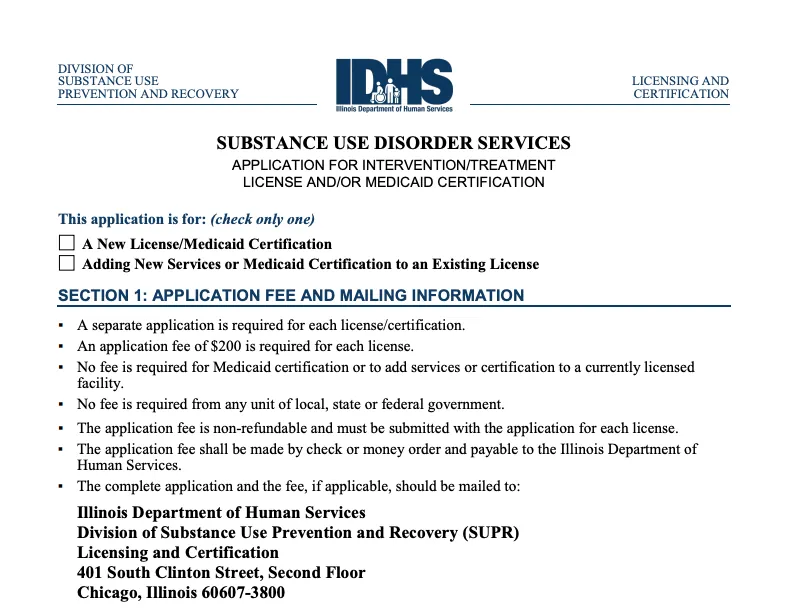
- Voluntary certification available through the IDHS application process
- Definition of recovery residences in state administrative code
- Consumer protections for residents of certified homes
- No mandatory licensing at the state level for peer-support recovery housing
The voluntary registry, maintained on the IDHS website, currently lists over 100 certified recovery residences and more than 50 Oxford Houses throughout the state. A state map of registered homes shows that the majority are concentrated in Cook County and the northeastern collar counties.
How Illinois Defines Recovery Residences
The Illinois Department of Human Services draws a clear distinction between different types of recovery housing. Understanding these definitions is essential for selecting the correct certification pathway.
Recovery residence is the umbrella term that includes both recovery homes and peer-run Oxford Houses. Under Illinois Administrative Code Title 77, Part 2060.509, the state defines recovery homes as:
Alcohol and drug free housing components whose rules, peer-led groups, staff activities and/or other structured operations are directed toward maintenance of sobriety for persons who exhibit treatment resistance, relapse potential and/or lack of suitable recovery living environments or who recently have completed substance use disorder treatment services or who may be receiving such treatment services at another licensed facility.
In practical terms, recovery homes can be for-profit or nonprofit organizations that provide housing to people in treatment or recovery from substance use disorders. They may follow the “Florida Model” with ties to an outpatient treatment center or operate as standalone facilities. They are distinct from Oxford Houses, which are self-governing, democratically run residences with no paid staff.
Will Illinois Move Toward Mandatory Regulation?
The 2019 law is widely viewed as a foundation for future regulatory expansion. Illinois has a history of NIMBY-led opposition campaigns against sober living operators, with some municipalities facing federal lawsuits for violating fair housing laws. These ongoing tensions between communities and recovery housing operators increase the likelihood that Illinois will strengthen oversight requirements over time.
For operators, this means that voluntary certification today positions you ahead of potential mandatory requirements tomorrow. Homes that are already certified and compliant will face minimal disruption if and when the state tightens regulations.
Step 1: Form Your Business Entity
Before signing a lease or purchasing property, establish the legal foundation for your sober living home operation.
Choose Your Business Structure
| Structure | Best For | Key Considerations |
|---|---|---|
| LLC | For-profit single or multi-home operators | Pass-through taxation, liability protection, simpler formation |
| S-Corp | Higher-revenue operators ($80K+ net income) | Potential payroll tax savings, more complex administration |
| 501(c)(3) Nonprofit | Grant-seeking, mission-driven operators | Required for most federal grants, longer formation timeline (3-6 months for IRS determination) |
| Series LLC | Multi-property operators | Illinois allows Series LLCs; each property can be a separate series with isolated liability |
Illinois is one of the states that recognizes Series LLCs, which can be particularly advantageous for operators planning multiple recovery homes. Each property operates as a separate series within a single LLC, isolating liability without forming entirely separate entities.
Registration Steps
- Register with the Illinois Secretary of State — File Articles of Organization (LLC) or Articles of Incorporation (nonprofit) online at cyberdriveillinois.com. Filing fees are $150 for LLCs and $50 for nonprofits.
- Obtain an EIN — Apply through the IRS website (free, immediate approval for online applications).
- Register for Illinois state taxes — Register with the Illinois Department of Revenue via MyTax Illinois if you will have employees or collect any taxable services.
- Open a business bank account — Separate personal and business finances from day one. This is critical for liability protection and financial transparency.
Step 2: Understand Illinois Certification and the ILRRA
While state certification is voluntary, it provides significant competitive advantages. The certification ecosystem in Illinois involves two pathways that operators should understand.
IDHS State Certification
The Illinois Department of Human Services hosts a provider dashboard that includes links to the multipurpose application sober living homes can use to apply for state certification. Operators seeking certification typically select “Level 3.1 - Residential Extended Care” on page 4 of the application to describe a community-based residence providing 24-hour supervision and a structured environment for practicing recovery skills.
Illinois also provides a short FAQ on recovery homes that covers the registry and certification program basics.
ILRRA (NARR Affiliate) Certification
The Illinois Recovery Residence Association (ILRRA) is the state’s NARR affiliate, providing certification according to nationally recognized quality standards. ILRRA certification is separate from (and complementary to) the IDHS state registry, and it carries significant weight with treatment providers, courts, and funding agencies.
For a complete breakdown of the national NARR certification process, including all four levels of support, costs, and timelines, see our dedicated guide. The four NARR levels as they apply in Illinois are:
| NARR Level | Description | Illinois Application |
|---|---|---|
| Level I — Peer-Run | Democratic governance, no paid staff | Oxford House model; self-governing homes in Chicago and downstate |
| Level II — Monitored | House manager oversight, most common model | Majority of Illinois certified homes; suitable for first-time operators |
| Level III — Supervised | Structured programming with trained staff | Homes affiliated with treatment centers; growing in suburban markets |
| Level IV — Clinical | Licensed professionals, clinical services | Requires additional IDHS licensing; typically operated by treatment organizations |
Most first-time operators in Illinois pursue Level II certification, which provides a strong foundation of quality standards without requiring the clinical staffing of higher levels.
Benefits of Certification
Even though certification is voluntary, the practical advantages make it a strong recommendation for any serious operator:
- Referral access — Treatment centers, hospitals, and courts preferentially refer to certified homes
- Funding eligibility — SAMHSA grants, opioid settlement funds, and state programs increasingly require NARR certification
- Legal protection — Certified status strengthens your position in zoning disputes and NIMBY challenges
- Credibility — Families searching for recovery housing overwhelmingly prefer certified facilities
- Future-proofing — Positions your operation ahead of potential mandatory certification requirements
Step 3: Find and Secure Property
Property selection is one of the most consequential decisions you will make. Illinois offers dramatically different real estate markets depending on region.
Regional Market Analysis
Chicago Metro (Cook County)
- Highest demand and most competitive market
- Lease costs for an 8-12 bed property: $2,500-$4,500/month
- Property taxes among the highest in the nation (Cook County effective rate ~2.1%)
- Dense treatment center network provides strong referral pipelines
- NIMBY opposition most organized in affluent suburbs (Hinsdale, Naperville, Lake Forest)
Collar Counties (DuPage, Lake, Will, Kane, McHenry)
- Growing suburban markets with increasing demand
- Moderate lease costs: $2,000-$3,500/month for suitable properties
- Newer housing stock may require fewer renovations
- Some municipalities have attempted restrictive zoning (watch for conditional use permit requirements)
Downstate Illinois (Springfield, Champaign, Peoria, Rockford)
- Lower real estate costs: $1,200-$2,500/month for comparable properties
- Less competition but also thinner referral networks
- Treatment infrastructure less dense; may need to build referral relationships proactively
- Property taxes significantly lower than Cook County
- Community reception often more favorable than suburban Chicago
Property Requirements
Your property must meet residential building codes and be suitable for the number of residents you plan to house. Key requirements include:
- Minimum square footage — Follow local building codes (typically 70-100 sq ft per resident for sleeping areas)
- Bathroom ratios — Plan for at least one full bathroom per 4-6 residents
- Common areas — Living room, kitchen, and dining space adequate for your capacity
- Parking — Sufficient off-street parking to avoid neighborhood conflicts
- Fire safety — Smoke detectors, carbon monoxide detectors, fire extinguishers, and clear egress routes in every sleeping area
- ADA considerations — At least one accessible bedroom and bathroom if serving residents with mobility needs
Lease vs. Purchase
| Factor | Leasing | Purchasing |
|---|---|---|
| Upfront capital | Lower ($5K-$15K security + first/last) | Higher ($50K-$200K+ down payment) |
| Monthly cost | Fixed lease payment | Mortgage + taxes + maintenance |
| Flexibility | Easier to relocate if market shifts | Builds equity over time |
| Control | Landlord approval needed for modifications | Full renovation control |
| Best for | First-time operators, testing a market | Established operators, long-term commitment |
Many first-time Illinois operators start with a lease to minimize risk while learning the business, then transition to property ownership once occupancy and revenue stabilize.
Step 4: Navigate Zoning and Local Regulations
Zoning is where many Illinois operators encounter their first significant challenge. While the Fair Housing Act provides strong federal protections, navigating local municipal requirements takes preparation and sometimes legal advocacy.
Fair Housing Act Protections
People in recovery from substance use disorders are protected under the Fair Housing Act (FHA) as individuals with disabilities. This means:
- Your sober living home can operate in any residentially zoned area where similar group living arrangements are permitted
- Municipalities cannot impose discriminatory zoning restrictions targeting recovery housing
- You are entitled to file a reasonable accommodation request if local zoning creates barriers
- The landmark City of Edmonds v. Oxford House (1995) Supreme Court case affirmed these protections
Illinois-Specific Zoning Challenges
Illinois has 1,298 municipalities, each with its own zoning code. Some common approaches you may encounter:
Conditional Use Permits (CUPs) — Some municipalities require CUPs for “group homes” or “community residences.” If the CUP process imposes requirements beyond what is asked of other residential uses (such as public hearings or neighbor notification), this may constitute discrimination under the FHA.
Occupancy Limits — Municipalities sometimes attempt to limit the number of unrelated individuals in a single dwelling. The FHA requires reasonable accommodations to such limits for people with disabilities, including those in recovery.
Spacing Requirements — Some jurisdictions try to impose minimum distances between group homes. Federal courts have consistently struck down such requirements when applied to recovery housing.
NIMBY Opposition — As documented in federal lawsuits against Illinois municipalities, organized opposition from neighbors can lead communities to adopt discriminatory policies. Knowing your rights and being prepared to file fair housing complaints is essential.
Practical Steps for Zoning Compliance
- Research local zoning codes before signing a lease or purchasing property
- Contact your municipality’s code enforcement office to confirm any local requirements
- File a reasonable accommodation request proactively if your municipality has restrictive group home provisions
- Document everything — keep written records of all interactions with municipal officials
- Engage a fair housing attorney if you encounter resistance; Illinois has active fair housing advocacy organizations
- Connect with ILRRA — the state NARR affiliate can provide guidance and advocacy support for zoning issues
Step 5: Secure Insurance Coverage
Adequate insurance coverage protects your investment, your residents, and your personal assets. Illinois has specific considerations that affect your insurance needs.
Required Coverage
| Coverage Type | Typical Cost (Annual) | Coverage Amount | Notes |
|---|---|---|---|
| Commercial General Liability | $1,500-$3,500 | $1M per occurrence / $2M aggregate | Required for NARR certification |
| Property Insurance | $800-$2,500 | Replacement value of contents + structure | Higher in Cook County |
| Professional Liability (E&O) | $500-$1,500 | $1M per occurrence | Covers operational decisions |
| Workers Compensation | $1,200-$3,000 | State-mandated minimums | Required if you have any employees in Illinois |
| Umbrella Policy | $500-$1,500 | $1M-$5M | Recommended for multi-home operators |
Illinois-Specific Insurance Considerations
- Cook County premiums tend to run 15-25% higher than downstate due to higher claim frequency and litigation rates
- Flood insurance may be required if your property falls within a FEMA-designated flood zone (check the Chicago metro area and river communities carefully)
- Winter liability — Snow and ice removal creates slip-and-fall exposure; ensure your general liability policy covers premises liability year-round
- Abuse and molestation coverage is increasingly required by referral partners and NARR affiliates
- Directors and Officers (D&O) insurance is recommended for nonprofit operators with a board of directors
Finding Insurance Providers
Standard homeowner or commercial property insurers often decline to cover sober living homes. Work with brokers who specialize in behavioral health or recovery housing. Request quotes from at least three providers and verify that each policy explicitly covers recovery residence operations.
Step 6: Develop Operational Policies
Strong operational policies protect residents, reduce liability, and satisfy certification requirements. Illinois does not mandate specific operational standards for uncertified homes, but NARR-aligned policies establish the foundation for quality operations.
House Rules and Resident Agreements
Every resident should sign a written agreement that clearly covers:
- Sobriety requirements — Zero tolerance for substance use on premises; drug and alcohol testing protocols
- Financial obligations — Rent amount, payment schedule, security deposit, and consequences of non-payment
- House rules — Curfew policies, guest policies, chore responsibilities, meeting attendance expectations
- Discharge procedures — Grounds for discharge, notice requirements, and appeal processes
- Rights and responsibilities — Resident rights per NARR standards, grievance procedures, and confidentiality protections
Staffing Requirements
Staffing needs depend on your NARR level and operational model:
- Level I (Peer-Run) — No paid staff; democratic governance among residents
- Level II (Monitored) — House manager (can be a senior resident or part-time employee), 24/7 contact availability
- Level III (Supervised) — Trained staff on-site during scheduled hours, structured programming
- Level IV (Clinical) — Licensed clinical staff; requires additional IDHS licensing beyond recovery residence certification
For most Illinois operators starting at Level II, plan for one house manager per home (often a part-time position that includes free or reduced housing) plus backup coverage for the house manager’s days off.
Drug Testing Protocols
Establish a consistent, documented drug testing program. Illinois does not mandate specific testing frequencies for uncertified homes, but NARR standards and best practices recommend:
- Testing upon intake (before or on day of admission)
- Random testing at least twice monthly
- Reasonable suspicion testing when warranted
- Documentation of all test results in resident files
- Clear policies on what constitutes a positive result and the consequences
Step 7: Estimate Startup Costs and Revenue
Understanding the financial picture before you begin is critical for long-term success. Here is what Illinois operators can realistically expect.
Startup Cost Breakdown
| Expense Category | Chicago Metro | Downstate | Notes |
|---|---|---|---|
| Entity formation & legal | $1,500-$3,500 | $1,000-$2,500 | LLC/nonprofit filing, attorney consultation |
| Property (first 3 months lease) | $7,500-$13,500 | $3,600-$7,500 | Security deposit + first/last month |
| Renovations & repairs | $15,000-$40,000 | $10,000-$25,000 | ADA modifications, fire safety, general updates |
| Furnishing (8-12 beds) | $8,000-$15,000 | $6,000-$12,000 | Beds, dressers, common area furniture, kitchen |
| Insurance (first year) | $4,500-$10,000 | $3,000-$7,000 | All required coverage types |
| ILRRA certification | $300-$750 | $300-$750 | Application fee + per-bed fees |
| Technology & software | $1,200-$3,600 | $1,200-$3,600 | Recovery residence management software, security cameras |
| Operating reserves (3-6 months) | $15,000-$30,000 | $8,000-$18,000 | Covers expenses during ramp-up |
| Marketing & website | $2,000-$5,000 | $1,500-$3,500 | Initial marketing to generate referrals |
| TOTAL ESTIMATED | $55,000-$121,350 | $34,600-$79,850 | Range based on 8-12 bed home |
Revenue Projections
Illinois sober living homes typically charge weekly or monthly rent. Rates vary significantly by region:
| Region | Weekly Rate | Monthly Rate | Annual Revenue (10-bed, 85% occupancy) |
|---|---|---|---|
| Chicago (city) | $150-$250 | $600-$1,000 | $61,200-$102,000 |
| Suburban Cook/Collar | $175-$300 | $700-$1,200 | $71,400-$122,400 |
| Downstate (larger cities) | $100-$175 | $400-$700 | $40,800-$71,400 |
| Downstate (smaller markets) | $75-$150 | $300-$600 | $30,600-$61,200 |
Most well-managed Illinois sober living homes reach profitability within 6-12 months, with mature homes achieving 20-35% profit margins. The path to profitability depends heavily on maintaining high occupancy rates (target 80%+ within 6 months of opening).
Funding Sources
Beyond resident rent, Illinois operators can pursue several funding sources:
- Illinois opioid settlement funds — Approximately $760 million allocated over 18 years
- SAMHSA grants — Federal recovery housing grants ($50K-$500K annually)
- HUD Continuum of Care — Available through Illinois Balance of State or Chicago CoC
- State Block Grant funding — Through IDHS Division of Substance Use Prevention and Recovery
- SBA loans — Small Business Administration 7(a) loans available for recovery housing businesses
Step 8: Build Your Referral Network
In Illinois, referrals are the lifeblood of recovery housing occupancy. Building relationships takes time and consistent effort.
Key Referral Sources in Illinois
Treatment Centers — Illinois has over 800 licensed substance use disorder treatment facilities. Focus on building relationships with outpatient programs, as their clients are the primary pipeline for sober living homes. Start with programs geographically close to your home and expand from there.
Hospitals and Emergency Departments — Many Illinois hospitals have dedicated behavioral health or addiction medicine departments. Cook County Health, Northwestern Medicine, Rush, and Advocate Aurora all have substance use disorder programs that refer to recovery housing.
Courts and Probation — Illinois drug courts and probation departments frequently mandate or recommend sober living as a condition of supervision. Contact your county’s drug court coordinator and adult probation department. Certification significantly increases court referral likelihood.
Recovery Community Organizations — Connect with local AA/NA groups, recovery community centers, and peer support organizations. Word-of-mouth referrals from the recovery community often produce the most committed, long-term residents.
ILRRA Directory — Once certified, your home appears in the ILRRA directory, which treatment providers and families search when seeking placement options.
Marketing Your Home
Effective marketing for Illinois sober living homes combines digital presence with relationship building:
- Website with local SEO — Target “sober living [your city] Illinois” and related keywords
- Google Business Profile — Claim and optimize your listing with photos, services, and reviews
- Treatment center outreach — Schedule in-person visits to introduce your home and leave brochures
- Community events — Attend recovery community events, health fairs, and ILRRA meetings
- Online directories — List on SAMHSA’s treatment locator, SoberHouse.com, and state directories
Managing Day-to-Day Operations
Once you open your doors, efficient daily operations determine whether your home thrives or struggles. Technology plays a critical role in scaling operations while maintaining quality.
Resident Management
Track each resident’s journey from intake through discharge using structured processes:
- Admission screening — Verify recovery commitment, review history, conduct intake assessment
- Onboarding — House tour, rule review, signed agreements, introduction to other residents
- Ongoing monitoring — Drug testing, meeting attendance, employment or program participation
- Discharge planning — Prepare residents for independent living with transition support
Financial Management
Rent collection is the operational foundation of your sober living home. Establish clear payment systems from day one:
- Accept multiple payment methods (bank transfer, credit card, cash with receipts)
- Automate rent reminders and track payment history
- Maintain transparent financial records for certification audits
- Track expenses by category for accurate profit-and-loss reporting
Using Technology to Scale
Recovery residence software replaces spreadsheets and paper files with integrated management tools. Purpose-built platforms like Sober Living App handle admissions, billing, resident management, drug testing documentation, and compliance tracking from a single dashboard. This is especially valuable for Illinois operators managing multiple homes across different regions of the state.
Illinois-Specific Compliance Considerations
Beyond federal and NARR standards, Illinois operators should be aware of state-specific compliance requirements.
Property Tax Considerations
Illinois has some of the highest property taxes in the nation, particularly in Cook County. Nonprofit operators may qualify for property tax exemptions under the Illinois Property Tax Code if the property is used exclusively for charitable purposes. Consult with a tax attorney to determine eligibility.
Employment Law
If you hire staff (house managers, peer support specialists, maintenance), Illinois employment law applies:
- Minimum wage — $15.00/hour statewide (higher in some municipalities; Chicago has its own schedule)
- Workers compensation — Mandatory for all employers
- Illinois Human Rights Act — Prohibits employment discrimination; broader protections than federal law
- Background checks — Illinois limits how employers can use criminal history in hiring decisions (Ban the Box law)
Confidentiality Requirements
All sober living homes must comply with federal confidentiality regulations (42 CFR Part 2) that protect substance use disorder treatment records. In practice, this means:
- Never disclose a resident’s identity or treatment status without written consent
- Maintain secure records (physical locks for paper files, encrypted digital systems)
- Train all staff on confidentiality obligations
- Include confidentiality protections in your resident agreement
Fire and Safety Codes
Contact your local fire marshal’s office for specific requirements. Common Illinois requirements include:
- Working smoke detectors in every bedroom and on every level
- Carbon monoxide detectors on every level
- Fire extinguishers on each floor (inspected annually)
- Posted evacuation plans
- Clear egress paths from all sleeping areas
- Annual fire safety inspections (required in many municipalities)
Common Mistakes to Avoid
Learning from the experiences of other Illinois operators can save you significant time, money, and frustration.
Ignoring local municipal requirements. The 2019 state law created a voluntary framework, but your city or county may have additional licensing, permitting, or inspection requirements. Always check locally before assuming state rules are all that apply.
Skipping certification. While voluntary, operating without NARR certification in Illinois limits your referral access, funding eligibility, and credibility. The investment is modest compared to the long-term benefits.
Underestimating Cook County property taxes. If you purchase property in Cook County, budget for effective property tax rates of 2% or higher. This can add $5,000-$15,000+ annually to your operating costs for a typical sober living property.
Choosing location based solely on cost. A cheaper downstate property with no referral network will underperform a more expensive suburban property near treatment centers. Match your location to available referral sources.
Failing to document everything. From resident agreements to drug test results to maintenance records, thorough documentation protects you legally, supports certification, and provides data for grant applications.
Not building reserves. Plan for at least three to six months of operating expenses in reserve. Illinois winters can affect occupancy, and building a referral pipeline takes time.
Next Steps for Illinois Operators
Opening a sober living home in Illinois is a multi-step process that rewards thorough preparation. Here is a recommended timeline for getting started:
Months 1-2: Planning and Formation
- Research your target market (Chicago metro vs. downstate)
- Consult with a local attorney experienced in recovery housing
- Form your business entity (LLC, nonprofit, or Series LLC)
- Begin the startup planning process
Months 2-4: Property and Compliance
- Identify and secure property
- Verify local zoning compliance and file reasonable accommodation requests if needed
- Obtain required insurance coverage
- Begin ILRRA certification process
Months 4-6: Buildout and Preparation
- Complete renovations and furnishing
- Develop operational policies and resident agreements
- Hire house manager and train staff
- Set up management software and financial systems
Months 5-7: Marketing and Launch
- Build referral relationships with treatment centers and courts
- Launch website and digital marketing
- Join ILRRA and attend networking events
- Accept first residents
Months 7-12: Stabilization and Growth
- Focus on reaching 80%+ occupancy
- Refine operations based on early experience
- Complete ILRRA certification if not already finalized
- Evaluate expansion opportunities
Need Help Managing Your Illinois Sober Living Home?
Sober Living App is dedicated to making it easier and more profitable to operate sober living homes. Our all-in-one platform handles rent collection, admissions, property management, resident care coordination, community contacts, transportation details, calendars, staff management, alumni tracking, and more — all from the convenience of your phone.
Claim your free trial today and see why recovery housing operators across Illinois and the nation prefer Sober Living App.
Frequently Asked Questions
Do I need a license to open a sober living home in Illinois?
Illinois does not require a state license to operate a sober living home. The state uses a voluntary certification and registry system administered by the Illinois Department of Human Services (IDHS). However, local municipalities may impose their own licensing, zoning, or permitting requirements. While state certification is optional, obtaining it through the ILRRA (Illinois NARR affiliate) strengthens credibility and opens access to referrals and funding.
How much does it cost to start a sober living home in Illinois?
Startup costs in Illinois typically range from $40,000 to $150,000 depending on location and size. In the Chicago metro area, expect higher real estate costs ($2,000-$4,500/month lease for an 8-12 bed property) compared to downstate markets ($1,200-$2,500/month). Major expenses include property lease or purchase, renovations ($10,000-$40,000), furnishing ($5,000-$15,000), insurance ($3,000-$8,000/year), and three to six months of operating reserves.
What is the ILRRA and how does it certify sober living homes?
The Illinois Recovery Residence Association (ILRRA) is the NARR state affiliate for Illinois, formerly known as IAEC (Illinois Association of Extended Care). ILRRA certifies recovery residences according to NARR's four-level quality standards. Certification involves an application, documentation review, site inspection, and compliance with operational standards including governance, health and safety, ethics, and resident rights.
How does Illinois define a recovery residence?
The Illinois Department of Human Services defines a recovery residence as an umbrella term encompassing both recovery homes (staff-operated or organizational) and peer-run Oxford Houses. Recovery homes are alcohol and drug-free housing whose rules, peer-led groups, staff activities, or structured operations are directed toward maintenance of sobriety. They may serve people currently in treatment or those who have completed treatment.
What zoning do I need for a sober living home in Illinois?
Sober living homes are protected under the Fair Housing Act as housing for people with disabilities. You can generally operate in any residentially zoned area. However, some Illinois municipalities attempt to impose conditional use permits or special zoning for group homes. Federal law protects recovery residences from discriminatory zoning. Always file a reasonable accommodation request if your municipality attempts to block your home based on its use as recovery housing.
What insurance do I need for a sober living home in Illinois?
Illinois sober living homes need commercial general liability insurance ($1M-$2M coverage), property insurance, and professional liability (errors and omissions). If you have employees, Illinois requires workers compensation insurance. Illinois-specific considerations include higher premiums in Cook County, flood insurance if located in a FEMA-designated flood zone, and umbrella policies recommended for multi-home operations.
Can I open a for-profit sober living home in Illinois?
Yes. Illinois allows both for-profit and nonprofit sober living homes. The state's voluntary certification program is open to either structure. However, if you plan to pursue government grants (SAMHSA, HUD, opioid settlement funds), nonprofit 501(c)(3) status is typically required. Many operators start as for-profit LLCs and later establish a nonprofit arm for grant-eligible activities.
How long does it take to open a sober living home in Illinois?
Plan for 4 to 8 months from initial planning to accepting your first residents. This includes entity formation (2-4 weeks), property acquisition and renovation (6-12 weeks), insurance procurement (2-4 weeks), local permitting (4-8 weeks depending on municipality), and ILRRA certification if pursued (3-6 months, can run concurrently). Chicago and suburban Cook County often have longer permitting timelines than downstate communities.
What are the biggest challenges of operating a sober living home in Illinois?
Key challenges include NIMBY opposition (particularly in suburban Cook County and collar counties), high property taxes in the Chicago metro area, seasonal occupancy fluctuations during harsh winters, and navigating varying municipal regulations across the state's 1,298 municipalities. Building relationships with local treatment providers and the recovery community helps overcome referral challenges, especially downstate where treatment infrastructure is less dense.
Does Illinois have opioid settlement funding available for recovery housing?
Yes. Illinois received approximately $760 million from national opioid settlements distributed over 18 years. A portion is allocated to substance use disorder treatment and recovery support services, including recovery housing. Contact the Illinois Attorney General's office and IDHS for current funding opportunities. NARR certification through the ILRRA strengthens grant applications significantly.
Manage your homes more efficiently
From admissions to discharge, Sober Living App streamlines every aspect of running recovery residences.
Related Articles
How to Start a Sober Living Home: Complete 2026 Guide for Operators
Step-by-step guide to starting a sober living home in 2026. Learn startup costs ($50K-150K), revenue potential ($1,500-3,500/bed), licensing by state, and how to reach profitability in 6-18 months.
NARR Certification Guide: Complete Process for Recovery Residences
Step-by-step NARR certification guide for recovery residence operators. Covers all four levels, costs, timelines, state affiliates, and compliance tips.
Illinois NARR State Affiliate | Complete Guide
Illinois NARR affiliate for recovery housing certification. Requirements, NARR levels, benefits, and how to get your sober living home certified in Illinois.