
Opening a Sober Living Home in Georgia: Complete Guide [2026]
Complete guide to opening a sober living home in Georgia. GARR certification process, SB 4 compliance, startup costs, zoning, and funding for operators.
Legal Disclaimer
This article provides general information for educational purposes only. It is not legal, financial, or compliance advice. Recovery housing regulations vary by state, county, and municipality. You must consult with a qualified local attorney and your municipality's code enforcement office to confirm all requirements at every level of jurisdiction. Regulations change frequently — always verify current requirements directly with relevant government agencies.
Opening a sober living home in Georgia requires navigating GARR certification, SB 4 anti-brokering compliance, local zoning ordinances, and a rapidly evolving regulatory landscape that operators must understand before launching. Georgia does not require a state-level license for recovery residences, but local municipalities may have permitting, zoning, or occupancy requirements that you must verify. This guide walks operators through every step of opening and running a compliant, successful sober living home in the Peach State.
Georgia is one of the fastest-growing recovery housing markets in the Southeast, driven by rising demand for substance use disorder treatment and post-treatment transitional living. Whether you are launching your first recovery residence in Atlanta, Savannah, Augusta, or a smaller community, understanding the regulatory environment, certification process, and operational requirements is essential to long-term success.
For a broader overview of what it takes to launch a recovery residence nationwide, see our complete guide on how to start a sober living home. For a state-by-state breakdown of licensing requirements, visit our sober living home licensing requirements by state resource.
Georgia Sober Living Regulatory Landscape in 2026
As of 2026, Georgia maintains a relatively light regulatory framework for sober living homes compared to states like Florida, California, or Ohio. The state does not have a mandatory state-level licensing or certification program specifically for recovery residences, nor does it maintain a central registry tracking the location and number of sober living homes operating within its borders. However, local municipalities may impose their own licensing, permitting, or operational requirements that operators must research and comply with. This environment is changing — and operators who plan ahead will be better positioned when new requirements arrive.
Senate Bill 4: The First Major Legislation
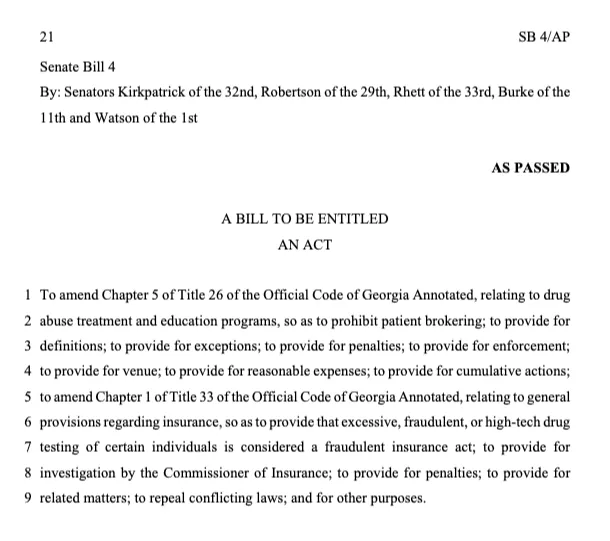
In July 2021, Georgia’s General Assembly passed Senate Bill 4 (SB 4), which marked the state’s first significant legislative action targeting recovery housing. SB 4 addressed two critical issues that had damaged the reputation of the sober living industry in Georgia:
Anti-patient brokering provisions. SB 4 made it a prosecutable offense for sober living homes to accept or pay “finder’s fees” or “referral fees” for directing residents to specific treatment providers, labs, or other services. This practice, sometimes called “body brokering,” had been exploited by bad actors who prioritized profit over resident well-being.
Fraudulent billing crackdown. The bill also targeted fraudulent insurance billing practices, particularly excessive and medically unnecessary drug testing. Some operators had been ordering frequent urine drug screens primarily to generate insurance revenue rather than to support residents’ recovery.
SB 4 passed the Georgia Senate unanimously, sending a clear signal that lawmakers across party lines view recovery housing accountability as a priority. For operators, the message is straightforward: ethical business practices are not optional, and the state is willing to legislate when the industry fails to self-regulate.
What Comes Next: Expected Regulatory Changes
Consider SB 4 as the first of several legislative actions aimed at reforming how sober living homes operate in Georgia. State lawmakers, including those who sponsored SB 4, have publicly stated their intent to introduce a formal certification process and legal definitions for recovery residences in the state. When (not if) this happens, the Georgia Department of Community Health is the most likely agency to oversee administration and enforcement. The Department already governs Georgia’s mandatory licensing program for addiction treatment providers — entities the state formally refers to as “Drug Abuse Treatment and Education Programs,” or DATEPs.
Georgia Regulatory Timeline
| Year | Development | Impact on Operators |
|---|---|---|
| Pre-2021 | No state-level recovery housing legislation | Operators self-regulate with minimal oversight |
| July 2021 | SB 4 signed into law | Patient brokering and fraudulent billing become prosecutable offenses |
| 2022-2025 | GARR grows membership; opioid settlement funds begin flowing | Voluntary certification increasingly tied to funding eligibility |
| 2026 | Formal certification legislation expected | Operators already GARR-certified will have a compliance head start |
Why Getting Ahead of Regulation Benefits Operators
Operators who voluntarily adopt NARR-aligned standards and pursue GARR certification now will have a significant competitive advantage when mandatory regulation arrives. These operators will already have documented policies, trained staff, compliant physical environments, and established relationships with oversight bodies. Those who wait may face expensive retrofitting, rushed compliance timelines, and potential disruption to operations.
Additionally, many referral sources — treatment centers, courts, probation departments, and insurance networks — already prefer or require GARR-certified recovery residences. Voluntary certification is increasingly becoming a de facto requirement for operators who want access to the best referral pipelines and funding opportunities.
GARR Certification: Georgia’s NARR Affiliate
The Georgia Association of Recovery Residences (GARR) is the NARR state affiliate responsible for certifying recovery residences in Georgia. Established over 30 years ago, GARR has been advocating for ethical and professional operation of sober living homes long before state lawmakers began paying attention to the industry.
For a comprehensive look at the national NARR certification framework that underpins GARR’s standards, visit our NARR certification guide.
NARR Certification Levels
GARR certification follows the national NARR framework, which defines four levels of recovery residence based on the intensity of services and structure provided:
Level 1 — Peer-Run. Democratically run residences with peer-based support. Minimal structure, resident-managed operations, and a focus on mutual accountability. This is the most common model for sober living homes.
Level 2 — Monitored. A designated house manager or senior resident provides oversight. Drug testing, house meetings, and basic accountability structures are in place. Many operators start at this level.
Level 3 — Supervised. Professional staff provide clinical oversight and coordination of care. Residents typically have access to counseling, case management, and structured programming. This level requires more resources and qualified personnel.
Level 4 — Service Provider. The highest level of care, offering comprehensive clinical services within the residential setting. This level often overlaps with licensed treatment facility requirements and is less common for standalone sober living homes.
Most new sober living operators in Georgia will pursue Level 1 or Level 2 certification. As your operation matures and you add services, you can pursue higher certification levels.
NARR Levels at a Glance
| Level | Governance | Staffing | Typical Georgia Operator |
|---|---|---|---|
| Level 1 — Peer-Run | Democratic/resident-led | No paid staff | First-time operators, Oxford House model |
| Level 2 — Monitored | House manager oversight | Paid house manager | Most common for new sober living homes |
| Level 3 — Supervised | Professional management | Clinical and support staff | Operators with treatment partnerships |
| Level 4 — Service Provider | Administrative leadership | Licensed clinical professionals | Integrated treatment and housing programs |
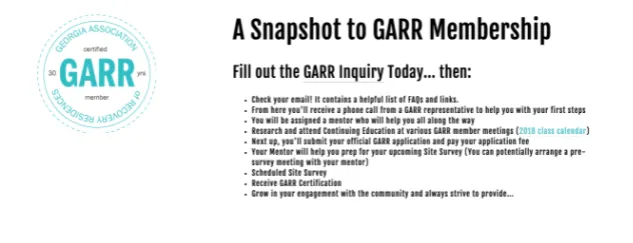
The GARR Certification Process
GARR provides a structured pathway to certification that includes several key steps:
- Membership application. Begin by applying for GARR membership and paying applicable fees.
- Standards review. GARR provides guidance on meeting NARR standards for operations, physical environment, recovery support services, and good neighbor practices.
- Documentation submission. Submit your policies, procedures, house rules, financial practices, and other documentation demonstrating compliance with NARR standards.
- Site inspection. GARR conducts a physical inspection of your facility to verify safety, accessibility, and compliance with environmental standards.
- Mentorship and support. Throughout the process, GARR provides one-on-one mentorship, continuing education, and member meetings to help operators succeed.
The full certification process typically takes 3-6 months from initial application to approval. GARR maintains a database of current members and certification requirements on their website.
Benefits of GARR Certification
- Funding eligibility. Many federal and state grants require or strongly prefer NARR-certified homes. GARR certification is increasingly a prerequisite for accessing SAMHSA grants, opioid settlement funds, and HUD Recovery Housing Program dollars.
- Referral network access. Treatment centers, courts, probation officers, and managed care organizations prefer to refer to certified residences. Certification puts you on preferred provider lists.
- Credibility and trust. Certification demonstrates to residents, families, and the community that your home meets national standards for quality and safety.
- Regulatory readiness. When Georgia introduces mandatory certification (which is expected), GARR-certified homes will already be compliant.
- Peer community. GARR membership connects you with other operators for shared learning, problem-solving, and advocacy.
Step-by-Step: How to Open a Sober Living Home in Georgia

Opening a sober living home involves careful planning across legal, operational, and community dimensions. Here is a step-by-step guide tailored to the Georgia market.
Step 1: Research Your Market
Before committing to a location, study the recovery housing landscape in your target area. Key markets in Georgia include:
- Atlanta metro area — The largest market with the highest demand, but also the most competition and highest property costs. Neighborhoods like Decatur, East Point, and Marietta have established recovery communities.
- Savannah — Growing demand for recovery housing with relatively lower operating costs than Atlanta. The tourism and hospitality industries contribute to substance use challenges that drive demand for recovery services.
- Augusta — Proximity to Fort Eisenhower (formerly Fort Gordon) creates demand for military-connected and veteran-focused recovery housing. The VA Medical Center in Augusta also generates referrals.
- Macon and Columbus — Smaller markets with less competition and lower startup costs, but smaller referral pipelines. These communities are underserved and present opportunity for operators willing to build relationships.
- Athens — Home to the University of Georgia, Athens has growing demand for young-adult recovery housing tied to college-age substance use patterns.
Research existing sober living homes in your target area, identify gaps in service (gender-specific housing, veteran-focused, MAT-friendly, etc.), and talk to local treatment providers about their referral needs.
Step 2: Create a Business Plan
Your business plan should cover:
- Mission and vision. Define the population you will serve and the level of support you will provide.
- Market analysis. Summarize your research on demand, competition, and referral sources in your target Georgia market.
- Financial projections. Estimate startup costs, monthly operating expenses, and revenue based on occupancy and bed rates. Use the cost tables later in this guide as a starting point.
- Staffing plan. Determine whether you will manage the home yourself or hire a house manager and support staff.
- Growth strategy. Plan for how you will scale from one home to multiple properties over time.
- Compliance roadmap. Document your timeline for GARR certification, local permitting, and insurance procurement.
A solid business plan is also essential if you plan to seek grant funding or loans. For guidance on securing capital, see our guide on grants for recovery homes and halfway houses.
Step 3: Choose Your Business Entity
Georgia operators typically choose one of two structures:
- LLC (Limited Liability Company). The most common structure for for-profit sober living homes. LLCs provide personal liability protection and pass-through taxation. Registration is handled through the Georgia Secretary of State. Filing fees are relatively modest compared to other states.
- Nonprofit 501(c)(3). Required if you plan to accept certain grants (SAMHSA, HUD) or charitable donations. Nonprofits have additional governance requirements including a board of directors, but qualify for tax-exempt status and expanded funding opportunities.
Consult with an attorney and accountant to determine which structure best fits your goals. Many operators who plan to pursue grant funding as a primary strategy will benefit from establishing a nonprofit entity from the start.
Step 4: Find and Secure Property
Property selection is one of the most critical decisions you will make. Consider:
- Lease vs. purchase. Leasing reduces upfront costs and risk; purchasing builds equity but requires significant capital or financing.
- Residential zoning. Sober living homes are classified as residential use under the Fair Housing Act. Choose properties in residential neighborhoods where group living is permitted. For a detailed breakdown of zoning protections, see our sober living home zoning and Fair Housing guide.
- Size and layout. Most sober living homes accommodate 6-16 residents, though maximum occupancy limits vary by municipality and may be more restrictive in your area — always verify local occupancy rules with your city or county code enforcement office. Look for properties with multiple bedrooms, adequate bathrooms (at least one per four residents), common living areas, and off-street parking.
- Proximity to services. Residents benefit from proximity to public transportation, employment opportunities, 12-step meetings, outpatient treatment, and grocery stores. In Atlanta, MARTA access is a significant advantage. In smaller Georgia cities, walkability and proximity to bus routes matter.
Step 5: Ensure Compliance with Local Zoning and Building Codes
Even though Georgia lacks state-level sober living licensing, local municipalities may have zoning ordinances, occupancy limits, and building code requirements that apply. Key steps include:
- Contact your local planning and zoning department to verify that your property can be used as a group residence.
- Obtain any required business licenses or home occupation permits.
- Schedule a fire safety inspection and ensure smoke detectors, fire extinguishers, and egress routes meet local fire code.
- Confirm that the property meets ADA accessibility guidelines if you plan to serve individuals with physical disabilities.
- Research any county-level health department requirements for group living arrangements.
Georgia municipalities that have attempted to restrict recovery homes through zoning have faced legal challenges under the Fair Housing Act. However, proactive engagement with local government is always preferable to adversarial proceedings.
Step 6: Develop Policies and Procedures
Comprehensive written policies are essential for GARR certification and day-to-day operations. Core policies include:
- House rules (curfew, chores, guest policies, drug and alcohol prohibitions)
- Drug testing protocols and consequences for positive results
- Admission and discharge criteria
- Grievance and complaint procedures
- Emergency response plans (medical emergencies, severe weather, fire)
- Financial policies (rent collection, deposits, refunds, late payment procedures)
- Medication management (if applicable)
- Good neighbor policies (noise, parking, property maintenance)
- Relapse response procedures with clear, compassionate protocols
- Anti-discrimination and equal opportunity policies
Document everything in a resident handbook that each incoming resident reviews and signs during intake.
Step 7: Secure Insurance Coverage
Insurance is a non-negotiable requirement for responsible sober living operations. At minimum, Georgia operators should carry:
- Commercial general liability insurance — Covers injuries, property damage, and legal claims
- Property insurance — Covers damage to the building and contents (required if you own; often required by landlords if you lease)
- Directors and officers insurance — Recommended for nonprofits to protect board members
- Workers’ compensation — Required by Georgia law if you have three or more employees
- Professional liability (errors and omissions) — Covers claims related to the services you provide
Specialized insurance providers for recovery housing and behavioral health can offer policies tailored to the unique risks of sober living operations. For comprehensive coverage guidance, see our sober living home insurance guide.
Step 8: Apply for GARR Certification
Once your policies, property, and operations are in place, submit your GARR membership application. GARR will guide you through the certification process, which involves documentation review and a physical site inspection. Starting this process early — even before you open — gives you time to address any gaps and demonstrates good faith to referral partners.
Step 9: Set Up Operations
Operational readiness includes:
- Staffing. Hire or designate a house manager. Depending on your certification level, you may also need peer support staff, case managers, or clinical personnel.
- Intake process. Develop a structured intake procedure including application screening, orientation, house rule review, and agreement signing.
- Financial systems. Set up rent collection, accounting, and financial reporting. Recovery residence management software can automate rent collection, bed tracking, compliance documentation, and resident records — replacing manual spreadsheets that become unmanageable as you scale.
- Supply and furnish the home. Each resident needs a bed, storage space, and access to shared amenities (kitchen, laundry, common areas). Budget for quality mattresses, durable furniture, and adequate kitchen supplies.
Step 10: Build Referral Relationships
Referrals are the lifeblood of a successful sober living home. Key referral sources in Georgia include:
- Residential and outpatient treatment centers
- Hospital discharge planners
- Drug courts and probation/parole officers
- Veterans Affairs (especially in Augusta and Atlanta)
- DBHDD community service boards (there are 25 across Georgia)
- Private therapists and psychiatrists
- 12-step and other recovery community organizations (RCOs)
- Faith-based organizations and churches
Visit referral sources in person, provide printed information about your home, and follow up regularly. GARR certification significantly strengthens your credibility with referral partners. Build relationships before you need them — the time to connect with treatment centers is during your setup phase, not after you open with empty beds.
Step 11: Launch and Market Your Home
When you are ready to accept residents:
- List your home on recovery housing directories (GARR directory, SAMHSA locator)
- Create a professional website with photos, house rules, services, and contact information
- Establish a Google Business Profile for local search visibility
- Maintain active relationships with referral sources through regular check-ins
- Ask satisfied residents and alumni for testimonials (with appropriate consent and HIPAA-compliant processes)
- Attend local recovery community events and GARR member meetings to maintain visibility
Georgia Sober Living Startup Costs
Understanding your financial requirements before launching is critical. Costs vary significantly based on location, property type, and level of service. Here is a detailed breakdown for Georgia operators.
Startup Cost Estimates
| Cost Category | Lease Model | Purchase Model |
|---|---|---|
| First/last month rent or down payment | $3,000 - $8,000 | $20,000 - $60,000+ |
| Furnishing (beds, common areas, kitchen) | $3,000 - $10,000 | $3,000 - $10,000 |
| Deposits and utilities setup | $1,000 - $3,000 | $1,000 - $3,000 |
| Insurance (liability, property) | $1,500 - $4,000/year | $2,000 - $6,000/year |
| GARR certification fees | Contact GARR | Contact GARR |
| Business registration and legal | $500 - $2,000 | $500 - $2,000 |
| Drug testing supplies | $500 - $1,500 | $500 - $1,500 |
| Technology and software | $100 - $500 | $100 - $500 |
| Initial marketing and outreach | $500 - $2,000 | $500 - $2,000 |
| Initial operating reserves (3 months) | $5,000 - $15,000 | $5,000 - $15,000 |
| Total Estimated Startup | $15,000 - $46,000 | $35,000 - $100,000+ |
Atlanta Metro vs. Smaller Markets
Property costs drive the biggest difference between Georgia markets. The table below compares monthly rental costs for a typical 6-bedroom sober living property across key Georgia cities.
| Market | Monthly Rent (6-Bedroom) | Bed Rate Range | Competition Level |
|---|---|---|---|
| Atlanta (Decatur, Marietta, East Point) | $2,500 - $4,000 | $700 - $1,400 | High |
| Savannah | $1,800 - $3,000 | $600 - $1,100 | Moderate |
| Augusta | $1,400 - $2,500 | $550 - $1,000 | Low to moderate |
| Macon | $1,200 - $2,000 | $500 - $900 | Low |
| Columbus | $1,200 - $2,000 | $500 - $900 | Low |
| Athens | $1,600 - $2,800 | $550 - $1,000 | Low |
Operators in smaller markets benefit from lower overhead but may need to invest more time and energy building referral pipelines. Atlanta operators face higher costs but have access to a larger pool of treatment centers, courts, and community organizations generating referrals.
Monthly Operating Costs
Typical monthly operating expenses for a sober living home in Georgia include:
| Expense | Monthly Estimate |
|---|---|
| Rent/mortgage | $1,200 - $4,000 |
| Utilities (electric, water, internet, gas) | $400 - $800 |
| House manager compensation | $2,000 - $4,000 |
| Insurance (monthly equivalent) | $125 - $500 |
| Supplies and maintenance | $300 - $800 |
| Drug testing | $200 - $500 |
| Software and technology | $50 - $200 |
| Marketing and outreach | $100 - $500 |
| Accounting and bookkeeping | $200 - $500 |
| Miscellaneous and contingency | $200 - $500 |
| Total Monthly | $4,775 - $12,300 |
Revenue Potential
Monthly rent for sober living beds in Georgia typically ranges from $500-$900 per bed in smaller markets and $700-$1,400 per bed in the Atlanta metro area. A well-managed home with 8 beds at 85% average occupancy can generate meaningful revenue — however, 85% is a mature-operation benchmark, not a first-year expectation. New operators should plan conservatively and may experience significantly lower occupancy during the first 6-12 months while building referral relationships and community reputation.
The table below illustrates revenue scenarios for an 8-bed Georgia home at different occupancy levels.
| Scenario | Occupancy | Avg Bed Rate | Monthly Revenue | Annual Revenue |
|---|---|---|---|---|
| Conservative (Year 1) | 50% | $700 | $2,800 | $33,600 |
| Moderate (Year 1-2) | 70% | $750 | $4,200 | $50,400 |
| Stabilized (Year 2+) | 85% | $800 | $5,440 | $65,280 |
| Optimized (Mature) | 90% | $900 | $6,480 | $77,760 |
Revenue projections should account for ramp-up time, seasonal fluctuations, and the possibility that stabilized occupancy may take longer to achieve than anticipated. Operators running multiple homes achieve economies of scale on staffing, insurance, and administrative costs.
Funding Opportunities for Georgia Sober Living Homes
Securing funding can significantly reduce your financial risk and accelerate your launch. Several federal and state programs provide grants and financial assistance for recovery housing operators. However, eligibility requirements are strict, funding is competitive, and not all operators will qualify. Grant programs often require nonprofit status, NARR certification, demonstrated operational history, or specific population focus. The funding sources described below are not guaranteed — always verify current availability, eligibility criteria, and application deadlines directly with the administering agency.
For a comprehensive overview of funding opportunities nationwide, see our guide on grants for recovery homes and halfway houses.
SAMHSA Grants
The Substance Abuse and Mental Health Services Administration (SAMHSA) offers multiple grant programs that support recovery housing, including the Recovery Housing Program and various discretionary grants. GARR certification significantly strengthens your application, as SAMHSA prioritizes NARR-certified residences. Grant announcements are posted on grants.gov and the SAMHSA website.
Georgia Opioid Settlement Funds
Georgia is receiving substantial opioid settlement allocations from litigation against pharmaceutical manufacturers and distributors. These funds flow through the Georgia Department of Behavioral Health and Developmental Disabilities (DBHDD) and are designated for substance use disorder treatment and recovery support services, including recovery housing. Georgia’s opioid settlement governance structure directs funds through regional distribution, meaning operators in underserved areas outside Atlanta may find competitive advantages. Contact DBHDD directly for information on current funding opportunities and application processes.
HUD Recovery Housing Program
The U.S. Department of Housing and Urban Development (HUD) Recovery Housing Program provides funding specifically for stable, temporary housing for individuals in recovery from substance use disorders. Funds are distributed through state agencies, and Georgia operators should contact DBHDD and their local Continuum of Care for application information.
State Behavioral Health Block Grants
Georgia receives federal Substance Abuse Prevention and Treatment Block Grant funds, a portion of which may be allocated to recovery housing. These funds are administered through DBHDD and distributed to community service boards and other providers across the state. Georgia has 25 community service boards, and building relationships with your local board can open doors to state-funded programming and referrals.
Tips for Grant Competitiveness
- Obtain GARR certification before applying — many grants require it
- Organize as a 501(c)(3) nonprofit if you plan to pursue grants as a primary funding strategy
- Develop strong data collection and outcome measurement practices using recovery residence software
- Build partnerships with treatment providers, courts, and community organizations
- Maintain clean financial records and demonstrate fiscal responsibility
- Document resident outcomes including employment rates, length of stay, and sobriety milestones
- Align your application narratives with Georgia-specific needs data from DBHDD reports
Georgia Recovery Housing Market Overview
Georgia’s recovery housing market is shaped by the state’s ongoing battle with substance use disorders, a growing population, and increasing recognition of recovery housing as a critical component of the treatment continuum.
Opioid Crisis Impact
Georgia has been significantly affected by the opioid epidemic. According to the Georgia Department of Public Health, opioid-related overdose deaths have increased substantially over the past decade, and the state has seen growing prevalence of fentanyl and methamphetamine use alongside traditional opioid misuse. This crisis has driven increased demand for treatment services at every level, including recovery housing.
Demand for Recovery Housing
The gap between available treatment capacity and demand remains significant across Georgia. Many individuals completing residential treatment or detox have nowhere to go, and the shortage of quality recovery housing contributes to relapse and homelessness. This unmet demand represents both a public health need and an opportunity for operators committed to providing quality services.
Key Markets
- Atlanta metro — By far the largest market, with a diverse population, extensive treatment infrastructure, and strong referral networks. Competition is higher, but demand supports it. The I-285 corridor and surrounding suburbs offer diverse property options at varying price points.
- Savannah — A growing market with increasing demand driven by tourism industry-related substance use challenges and an expanding treatment community. Chatham County’s opioid response initiatives create partnership opportunities.
- Augusta — Fort Eisenhower (formerly Fort Gordon) creates demand for military-connected and veteran-focused recovery housing. The Charlie Norwood VA Medical Center is a key referral partner.
- Macon and Columbus — Underserved markets with growing need and limited existing recovery housing supply. Lower costs of entry make these attractive for new operators willing to invest in community relationship building.
- Rural Georgia — Significant unmet need exists in rural counties where treatment options are scarce. Operators serving these areas may face longer commute distances for residents accessing services but encounter virtually no competition.
Competition Landscape
While Georgia’s recovery housing market is growing, it remains less saturated than states like Florida, California, or Arizona. The absence of mandatory certification means that quality varies widely — which presents an opportunity for operators who pursue GARR certification and commit to NARR standards to differentiate themselves. GARR-certified operators report stronger occupancy rates and better referral relationships than non-certified competitors.
Georgia-Specific Compliance Requirements
Even without state-level licensing, Georgia sober living operators must navigate several compliance areas. Local municipalities may have their own requirements beyond what is described here — always check with your city or county government.
Local Zoning Considerations
Georgia municipalities have their own zoning ordinances that may affect where recovery residences can operate. Some cities have attempted to restrict group homes through special use permit requirements or occupancy limits. However, the federal Fair Housing Act generally protects recovery residences from discriminatory zoning practices. The landmark City of Edmonds v. Oxford House (1995) Supreme Court case confirmed that the FHA applies to municipal zoning ordinances affecting recovery housing. If you encounter zoning challenges, consult with an attorney experienced in Fair Housing law. For detailed guidance, see our sober living home zoning and Fair Housing guide.
Fair Housing Act Protections
Under the federal Fair Housing Act and the Americans with Disabilities Act, individuals in recovery from substance use disorders are considered to have a disability and are protected from housing discrimination. This means that:
- Municipalities cannot zone out sober living homes based on the disability status of residents
- Landlords cannot refuse to rent to you because the property will be used as a recovery residence
- Reasonable accommodations must be made for residents with disabilities
- Spacing and concentration ordinances targeting recovery homes specifically are subject to legal challenge
These protections apply in Georgia and all other states. Operators should document any discriminatory actions and consult legal counsel if needed.
Fire Safety and Building Codes
All sober living homes must comply with local fire safety codes. Common requirements in Georgia jurisdictions include:
- Working smoke detectors in every bedroom and common area
- Carbon monoxide detectors on each floor
- Fire extinguishers accessible on each level
- Two means of egress from each sleeping area
- Emergency evacuation plan posted in common areas
- Regular fire drills (recommended quarterly)
Schedule an inspection with your local fire marshal before opening to identify and address any deficiencies. Georgia fire marshals operate at the county level — contact your county fire department for scheduling.
Insurance Requirements
At minimum, Georgia sober living operators should carry:
- General liability insurance — Covers injuries, property damage, and legal claims
- Property insurance — Covers damage to the building and contents (required if you own; often required by landlords if you lease)
- Directors and officers insurance — Recommended for nonprofits
- Workers’ compensation — Required by Georgia law if you have three or more employees
Specialized insurance providers for recovery housing and behavioral health can offer policies tailored to the unique risks of sober living operations. See our sober living home insurance guide for a complete breakdown of coverage types and provider selection.
Drug Testing Policies
While Georgia does not mandate specific drug testing protocols for sober living homes, GARR certification requires documented testing policies. Best practices include:
- Random drug testing at established intervals
- Testing upon intake and for cause (suspected use)
- Clear consequences for positive results, documented in house rules
- Use of CLIA-waived testing devices or lab services
- Proper handling, chain of custody, and documentation of results
- SB 4-compliant testing practices — testing must serve clinical purposes, not revenue generation
Georgia Business Tax Obligations
Georgia sober living operators should be aware of state-specific tax obligations:
- Georgia state income tax applies to LLC profits (graduated rates up to 5.49% as of 2026)
- Sales tax does not apply to residential rent but may apply to other services
- Annual LLC registration fee is due to the Georgia Secretary of State
- Property taxes apply if you own the home; exemptions may be available for 501(c)(3) nonprofits
- Payroll taxes apply if you have employees (including workers’ compensation and unemployment insurance)
Consult with a Georgia-licensed CPA for guidance on your specific tax obligations.
Georgia Sober Living Operator Checklist
Use this checklist to track your progress toward opening a sober living home in Georgia:
| Step | Task | Status |
|---|---|---|
| 1 | Research target market and identify service gaps | Pending |
| 2 | Write business plan with financial projections | Pending |
| 3 | Choose business entity (LLC or 501(c)(3)) and register with Georgia Secretary of State | Pending |
| 4 | Secure property (lease or purchase) | Pending |
| 5 | Verify local zoning and obtain required permits | Pending |
| 6 | Pass fire safety inspection | Pending |
| 7 | Develop written policies and resident handbook | Pending |
| 8 | Secure insurance coverage (liability, property, workers’ comp) | Pending |
| 9 | Apply for GARR membership and begin certification process | Pending |
| 10 | Furnish the home and set up operational systems | Pending |
| 11 | Implement management software for billing and compliance | Pending |
| 12 | Build referral relationships with treatment centers and courts | Pending |
| 13 | Complete GARR certification | Pending |
| 14 | Launch marketing and open for residents | Pending |
How Sober Living App Helps Georgia Operators
Sober Living App is built specifically for recovery residence operators who want to run efficient, professional, and compliant homes.
Our all-in-one platform handles rent collection, admissions, property management, bed management, residents’ care coordination, housing notes, community contacts, transportation details, calendars, staff management, and alumni tracking — all from the convenience of your phone.
Whether you are opening your first home in Georgia or managing multiple properties across the state, Sober Living App gives you the tools to stay organized, maintain compliance documentation for GARR certification, and focus on what matters most: supporting your residents’ recovery.
Claim your free trial today and see why recovery residence operators across the country trust Sober Living App to manage their operations.
Frequently Asked Questions
Do I need a license to open a sober living home in Georgia?
Georgia does not require a specific state-level license for sober living homes, but local municipalities may have their own permitting, zoning, or occupancy requirements that you must verify. GARR (Georgia Association of Recovery Residences) certification is strongly recommended and increasingly required for funding. SB 4 (2021) established anti-patient-brokering rules, and further regulation is expected. Always consult a qualified attorney and your local code enforcement office.
What is GARR certification and how much does it cost?
GARR (Georgia Association of Recovery Residences) is the NARR state affiliate that certifies recovery residences in Georgia. Certification involves meeting NARR standards for operations, physical environment, recovery support, and good neighbor practices. Contact GARR at thegarrnetwork.org for current fees and application requirements.
How much does it cost to start a sober living home in Georgia?
Startup costs in Georgia typically range from $15,000-$100,000 depending on location, property type (lease vs purchase), and level of service. Major expenses include first/last month rent or down payment, furnishing, insurance, GARR certification fees, and initial operating reserves. Atlanta metro areas cost significantly more than rural Georgia communities.
What did Georgia SB 4 change for sober living homes?
Senate Bill 4 (2021) banned patient brokering in sober living homes, making finder's fees and referral fees a prosecutable offense. It also cracked down on fraudulent insurance billing practices including excessive drug testing. The bill passed unanimously and signals more regulation ahead for the recovery housing industry.
What funding is available for sober living homes in Georgia?
Georgia operators may be eligible to pursue SAMHSA grants, HUD Recovery Housing Program funds, and opioid settlement allocations through the state. GARR certification significantly improves grant competitiveness. Eligibility requirements, application deadlines, and available funding levels change frequently. Contact the Georgia Department of Behavioral Health and Developmental Disabilities (DBHDD) for current state-specific funding opportunities.
How long does GARR certification take?
GARR certification typically takes 3-6 months from initial application to approval. The process includes submitting documentation, paying fees, and passing a physical inspection of your facility. GARR provides mentorship and support throughout the process to help operators address gaps.
Can I open a sober living home in Atlanta with no experience?
Yes, but preparation is essential. New operators should study NARR standards, attend GARR member meetings for mentorship, build relationships with local treatment providers, and develop strong written policies before opening. Many successful Georgia operators start with a single Level 1 or Level 2 home and grow from there.
What insurance do I need for a sober living home in Georgia?
At minimum, Georgia operators should carry commercial general liability insurance, property insurance, and workers' compensation if employing staff. Directors and officers insurance is recommended for nonprofits. Specialized behavioral health insurance providers offer policies tailored to the unique risks of recovery housing operations.
Is Georgia a good state to open a sober living home?
Georgia offers strong fundamentals for recovery housing operators: growing demand driven by the opioid crisis, lower startup costs than coastal states, a less saturated market than Florida or California, and a supportive NARR affiliate (GARR) that provides certification and mentorship. The regulatory environment is evolving but currently maintains a relatively low barrier to entry.
What are the zoning requirements for sober living homes in Georgia?
Georgia does not have state-level zoning rules specific to sober living homes. However, local municipalities set their own zoning ordinances, occupancy limits, and building code requirements. Under the federal Fair Housing Act, sober living homes are protected from discriminatory zoning because residents in recovery are considered individuals with disabilities. Always verify local requirements with your city or county planning department.
Manage your homes more efficiently
From admissions to discharge, Sober Living App streamlines every aspect of running recovery residences.
Related Articles
How to Start a Sober Living Home: Complete 2026 Guide for Operators
Step-by-step guide to starting a sober living home in 2026. Learn startup costs ($50K-150K), revenue potential ($1,500-3,500/bed), licensing by state, and how to reach profitability in 6-18 months.
NARR Certification Guide: Complete Process for Recovery Residences
Step-by-step NARR certification guide for recovery residence operators. Covers all four levels, costs, timelines, state affiliates, and compliance tips.
Grants for Recovery Homes: Funding Guide [2026]
Apply for $50K-$500K federal grants (SAMHSA, HUD, DOJ), state opioid settlement funds, and foundation grants for recovery housing. Step-by-step application guide.