
How to Open a Sober Living Home in Texas: Complete 2026 Operator Guide
Start a sober living home in Texas: TROHN certification guide, local permitting requirements, zoning navigation, startup costs, and funding opportunities. Step-by-step guide for operators.

Legal Disclaimer
This article is for informational purposes only and does not constitute legal, financial, or compliance advice. Regulations vary by jurisdiction and change frequently. Consult qualified professionals for specific guidance on compliance requirements in your state.
How to Open a Sober Living Home in Texas: Complete 2026 Operator Guide
Important: This guide provides general information for educational purposes only. It is not legal, financial, or compliance advice. Recovery housing regulations vary significantly by city and county in Texas. Consult a qualified attorney familiar with your local jurisdiction’s zoning, boarding home ordinances, and fair housing law before opening a sober living home. Regulations change frequently — always verify current requirements with your city and county government.
Texas represents one of the largest untapped opportunities for sober living home operators in the United States. With a population of nearly 30 million people and a growing opioid crisis impacting communities statewide, demand for quality recovery housing far exceeds supply.
While Texas does not require a state-level license for sober living homes, the regulatory picture is more nuanced than it first appears. Major cities including Houston, Dallas, San Antonio, and El Paso have their own boarding home and group home ordinances that may require local permits, inspections, and fees. Voluntary certification through TROHN (Texas Recovery Oriented Housing Network) opens doors to referrals, funding, and credibility — and is increasingly required for any state-funded referrals.
What this guide covers:
- Texas legal requirements and TROHN certification process
- Step-by-step startup roadmap from business formation to opening day
- Startup costs by major Texas market (Houston, Dallas, Austin, San Antonio)
- $1.6 billion in opioid settlement funding and how to access it
- Zoning navigation and Fair Housing Act protections
- Building referral relationships with treatment centers and courts
Whether you’re a recovery professional expanding services or an entrepreneur passionate about helping others, this comprehensive guide provides everything you need to build a thriving sober living business in Texas while making a meaningful community impact.
Is Texas a Good Market for Sober Living Operators?
Texas offers exceptional opportunities for sober living home operators. Here’s why the Lone Star State should be on your radar.
Market Opportunity
Population and Demand:
- Nearly 30 million residents make Texas the second-largest state
- An estimated 2.4 million Texans struggle with substance use disorders
- The opioid crisis has hit Texas hard, with overdose deaths increasing 89% from 2019-2022
- Treatment center capacity has grown significantly, creating downstream demand for step-down housing
Economic Factors:
- Lower cost of living compared to California, New York, and Florida
- Strong job market helps residents achieve self-sufficiency
- No state income tax benefits both operators and residents
- Growing healthcare and treatment industry infrastructure
Regulatory Environment:
- No state-level license required for sober living homes (but local permits may be required — see below)
- Voluntary TROHN certification available; required for state-funded referrals
- Fair Housing Act protections apply to recovery residences
- Business-friendly state government, but major cities have specific boarding home ordinances
Competition Landscape by Market
| Market | Competition Level | Opportunity | Average Rent (5BR) |
|---|---|---|---|
| Houston | Moderate | Large population, strong treatment infrastructure | $2,200-3,800 |
| Dallas-Fort Worth | Moderate-High | Suburban opportunities, corporate relocations | $2,400-4,200 |
| Austin | High | Premium market, limited inventory | $2,800-4,800 |
| San Antonio | Low-Moderate | Growing market, affordable entry | $1,800-3,200 |
| Fort Worth | Moderate | Less competitive than Dallas, growing | $2,000-3,500 |
| El Paso | Low | Underserved, border region needs | $1,400-2,400 |
| Smaller Cities | Low | Emerging markets with high need | $1,200-2,200 |
Underserved Populations and Regions
Texas has significant unmet needs in several areas:
Underserved Regions:
- Rio Grande Valley
- East Texas (Tyler, Longview, Texarkana)
- Panhandle region (Amarillo, Lubbock)
- Central Texas outside Austin metro
Underserved Populations:
- Single parents in recovery
- Veterans (Texas has 1.5 million veterans)
- Spanish-speaking residents
- People with co-occurring mental health conditions
- Court-ordered and probation referrals
Texas Legal Requirements for Sober Living Homes
Good news for aspiring operators: Texas maintains one of the most operator-friendly regulatory environments in the nation for recovery housing.
State-Level Requirements
No State-Level License Required (But Local Rules Apply):
Texas does not require state licensure for sober living homes that provide housing and peer support without clinical treatment services. Unlike California or Florida, which have varying state certification requirements, Texas does not have a statewide licensing scheme for recovery residences.
However, this does not mean you can operate without permits. Major Texas cities have their own regulatory frameworks that may apply to your home (see “Local Requirements” below).
What You Can Provide Without State Licensing:
- Safe, drug-free housing environment
- Peer support and accountability
- House meetings about rules and responsibilities
- Drug and alcohol testing
- Transportation to external treatment and meetings
- Basic life skills support
- Structured living with curfews and house rules
- Connection to community recovery resources
What Triggers State Licensing Requirements:
If you provide any of the following, you’ll need certification from the Texas Health and Human Services Commission (HHSC) as a treatment facility:
- Detoxification services
- Group or individual counseling/therapy
- Treatment planning
- Medication management
- Clinical assessments
- Educational sessions focused on addiction treatment
The line at the state level is clear: housing and peer support do not require state licensure. Clinical treatment services do.
TROHN Certification: Strongly Recommended
While not legally required, certification through the Texas Recovery Oriented Housing Network (TROHN) provides significant advantages and is increasingly becoming essential for serious operators.
What is TROHN?
TROHN is the official NARR (National Alliance for Recovery Residences) affiliate for Texas. Authorized by the Texas Health and Human Services Commission under Texas Health & Safety Code Chapter 469, TROHN is the only organization in Texas that can certify all four NARR levels of recovery housing support.
Why TROHN Certification Matters:
As of 2023, any sober living home receiving state funding or referrals must be certified by TROHN or Oxford House. This makes certification essential if you plan to:
- Receive opioid settlement funding
- Accept referrals from state-funded treatment programs
- Work with courts and probation departments
- Partner with hospitals and healthcare systems
- Accept residents with state-funded housing vouchers
Certification Benefits:
- Listed in TROHN’s certified home directory
- Eligible for state funding and opioid settlement grants
- Preferred status with treatment center referrals
- Court and probation program recognition
- Enhanced credibility with families and residents
- Access to training and operator network
- Demonstrates commitment to quality standards
For complete details on TROHN certification, see our Texas NARR State Affiliate (TROHN) guide.
Local Requirements (Critical — Do Not Skip)
While Texas doesn’t require state licensing, major Texas cities have their own boarding home and group home ordinances that carry the force of law. Ignoring local regulations is the most common reason new sober living homes face fines, forced closures, or legal action.
City and County Boarding Home / Group Home Ordinances:
You must consult a qualified attorney and your specific city’s code enforcement office before signing a lease or beginning operations. Many major Texas cities — including but not limited to Houston, Dallas, San Antonio, and El Paso — have adopted boarding home or group home ordinances that may apply to sober living homes. These local ordinances can impose requirements including permits, annual inspections, fees, and background checks for staff. Requirements vary significantly by jurisdiction and change over time. It is your responsibility to determine, in consultation with legal and compliance professionals, which local regulations apply to your specific operation at every level of jurisdiction (city, county, and any applicable special districts).
City Business License:
- Register your business with your city
- Obtain a Certificate of Occupancy
- Check whether your city classifies your home as a “boarding home” or “group home” — this is often the trigger for additional permits and inspections
Building and Safety Codes:
- Fire safety compliance and inspections
- Building code adherence
- Health code compliance
- Smoke and carbon monoxide detectors
- Fire extinguishers and exit signage
Zoning Compliance:
- Verify residential zoning allows your intended use
- Understand occupancy limits for your zone — these vary by city (some allow 6 unrelated persons, others only 4)
- Check for any local ordinances specific to group homes or boarding homes
- Review HOA deed restrictions if applicable — these can create additional complications
Step-by-Step: Opening a Sober Living Home in Texas
Step 1: Form Your Business Entity
Choose Your Business Structure:
| Structure | Pros | Cons | Best For |
|---|---|---|---|
| LLC | Liability protection, flexibility, pass-through taxation | Self-employment taxes | Most operators |
| S-Corp | Potential tax savings, liability protection | More complex, payroll requirements | Higher-revenue operations |
| Non-Profit 501(c)(3) | Grant eligibility, tax exemption, donations deductible | Complex setup, oversight requirements | Mission-driven, grant-focused operations |
| Sole Proprietorship | Simple setup | Personal liability exposure | Not recommended |
Business Formation Steps:
- Choose your business name - Search the Texas Secretary of State database to ensure availability
- File with Texas Secretary of State - Submit Certificate of Formation online at sos.texas.gov
- Obtain EIN from IRS - Apply free at irs.gov (required for business bank account)
- Register with Texas Comptroller - For sales tax and franchise tax (even if you don’t collect sales tax)
- Open business bank account - Keep business and personal finances completely separate
- Set up accounting system - QuickBooks, Wave, or professional bookkeeper
Texas-Specific Considerations:
- Texas has no state income tax but does have a franchise tax for businesses over $1.23 million in revenue
- LLCs must file annual Public Information Reports with the Secretary of State
- Consider hiring a Texas business attorney for entity formation ($500-1,500)
Step 2: Secure Funding
Starting a sober living home in Texas requires significant upfront capital. Here’s a realistic breakdown of startup costs:
Startup Cost Breakdown:
| Expense Category | Low Estimate | High Estimate | Notes |
|---|---|---|---|
| Property (down payment or first/last/deposit) | $10,000 | $60,000 | Leasing vs. purchasing |
| Renovations and safety upgrades | $5,000 | $25,000 | Fire safety, accessibility |
| Furniture, beds, and equipment | $8,000 | $20,000 | Quality mattresses essential |
| Insurance (first year) | $8,000 | $20,000 | Liability, property — premiums for recovery residences have increased significantly |
| Legal and professional fees | $2,000 | $8,000 | Entity formation, contracts |
| Marketing and technology | $2,000 | $6,000 | Website, management software |
| TROHN certification | $600 | $1,500 | $500 + $10/bed + training |
| Operating capital (3-6 months) | $15,000 | $40,000 | Cover expenses before break-even |
| Total | $50,600 | $180,500 | Varies by market, approach, and local requirements |
Texas Funding Sources:
Opioid Settlement Funding:
Texas received approximately $1.6 billion in opioid settlement money, distributed over 18 years through the Texas Opioid Abatement Fund Council. Recovery housing is an approved use category.
Important eligibility context: These grants are competitive and primarily target established entities — counties, hospital districts, large nonprofits, and organizations with proven track records. A startup sober living home with no operating history is unlikely to receive direct settlement funds without partnering with an established organization.
- The 2026 grant cycle deadline is March 3, 2026 — check the Comptroller’s grant opportunities page for current cycle details
- Sign up for email updates from the Council
- TROHN certification is typically required for funding eligibility, but achieving Level 2/3 certification as a new operator can take longer than expected due to processing backlogs
- Consider partnering with an established organization to strengthen your application
Federal Grants:
- SAMHSA Recovery Housing Grants - $50,000-500,000 for qualifying programs
- HUD Recovery Housing Program - State-administered funds for transitional housing
- DOJ Second Chance Act - For facilities serving people leaving incarceration
- FEMA Emergency Funding - During declared disasters
Alternative Financing:
- Treatment center partnerships (referral guarantees for startup capital)
- SBA 7(a) loans for established operators
- Community Development Financial Institutions (CDFIs)
- Private investors or partners
- Crowdfunding for mission-driven projects
For comprehensive funding strategies, see our Grants for Recovery Homes guide.
Step 3: Find the Right Property
Property selection is critical to your success in Texas. Consider these factors carefully.
Property Costs by Major Market:
| City | Avg Monthly Rent (5-6 BR) | Purchase Price Range | Market Characteristics |
|---|---|---|---|
| Houston | $2,200-3,800 | $250,000-450,000 | Large market, strong treatment infrastructure, diverse neighborhoods |
| Dallas | $2,500-4,200 | $300,000-500,000 | Competitive, strong economy, suburban opportunities |
| Austin | $2,800-4,800 | $400,000-650,000 | Premium market, limited inventory, tech economy |
| San Antonio | $1,800-3,200 | $200,000-350,000 | Affordable entry, military/veteran population, growing |
| Fort Worth | $2,000-3,500 | $225,000-400,000 | Less competitive than Dallas, growing treatment market |
| Corpus Christi | $1,600-2,800 | $180,000-300,000 | Underserved market, lower competition |
| El Paso | $1,400-2,400 | $150,000-275,000 | Border region, bilingual population, unmet need |
Ideal Property Characteristics:
Location Factors:
- Residential neighborhood with good reputation
- Near public transportation (Metro, DART, VIA depending on city)
- Close to employment opportunities (retail, service industry)
- Proximity to treatment centers and recovery meetings
- Access to grocery stores and essential services
Property Features:
- 4-6 bedrooms for optimal occupancy
- Multiple bathrooms (aim for 1 per 3-4 residents)
- Large common areas for house meetings
- Adequate parking (1 space per resident minimum)
- Outdoor space for gatherings and recreation
- Separate room for office/intake interviews
What to Avoid:
- HOA-restricted communities (may prohibit group homes)
- Properties near schools or daycares (perception issues)
- High-crime neighborhoods
- Properties with major deferred maintenance
- Locations far from public transit and services
Lease vs. Purchase Considerations:
| Factor | Leasing | Purchasing |
|---|---|---|
| Initial Capital | Lower ($10-20K) | Higher ($50-100K down) |
| Monthly Cost | Fixed rent | Mortgage + maintenance |
| Flexibility | Can relocate easily | Long-term commitment |
| Equity Building | None | Build ownership stake |
| Landlord Approval | Required for use | Full control |
| Best For | First-time operators, testing markets | Established operators, long-term investment |
Finding Landlords Open to Sober Living:
Not all landlords will lease to sober living operators. Strategies for finding receptive property owners:
- Work with a real estate agent familiar with recovery housing
- Look for investor-owned properties (not owner-occupied)
- Contact property management companies directly
- Network with other sober living operators for referrals
- Consider properties that have been vacant for extended periods
- Be transparent about your operation from the beginning
Step 4: Navigate Zoning and Fair Housing
Texas sober living homes are protected under federal Fair Housing Act, but understanding local zoning is still essential.
Fair Housing Act Protections:
People in recovery from substance use disorders are considered disabled under the Fair Housing Act (FHA). This provides important protections, but the FHA is not an automatic shield against all local regulations:
- Cities cannot zone out recovery residences from residential areas based solely on the disability status of residents
- Sober living homes must generally be treated the same as any family residence
- Spacing requirements between recovery homes may be challengeable under the FHA
- Operators cannot be required to get special use permits that are not required of families
However, note: The FHA requires you to assert your rights — sometimes through a formal Reasonable Accommodation request. This process can be denied, and disputes may require legal action. Budget for legal counsel.
Practical Zoning Guidelines:
Occupancy Limits Vary by Jurisdiction:
You may encounter references to a “6-person rule” for Texas, but this is an oversimplification that can create legal problems:
- Texas municipalities set their own definitions of “family” and occupancy limits for unrelated persons — these can range from 4 to 6 or more depending on the jurisdiction
- Occupancy limits vary by city, county, and zoning district
- Exceeding your jurisdiction’s occupancy limit for unrelated persons may require a formal Reasonable Accommodation request under the FHA, which is a legal process that can be denied
- You must verify your specific city’s definition of “family” and occupancy limits with a local land use attorney before selecting a property
Larger Operations (7+ Residents):
For homes exceeding local occupancy limits, you may need:
- A formal Reasonable Accommodation request
- Conditional use permit
- Property in multi-family zoned area
- Variances or special exceptions
- Legal representation experienced in fair housing law
HOA and Deed Restrictions:
Homeowners Association (HOA) deed restrictions can create additional obstacles. While the FHA may override some HOA restrictions, this is not guaranteed and often requires legal action to resolve. Consider avoiding HOA-governed properties when possible.
Handling City Objections:
Some Texas cities and neighborhoods actively resist recovery housing. If you face opposition:
- Document all communications with city officials
- Reference Fair Housing Act protections
- Connect with Texas Fair Housing Action or HUD regional office
- Retain an attorney specializing in fair housing law — this is not optional if you face formal opposition
- Contact TROHN for guidance and support
- Be prepared for a formal Reasonable Accommodation process
Building Positive Community Relations:
Proactive community engagement prevents most problems and is your best defense against NIMBYism:
- Introduce yourself to neighbors before opening
- Provide your contact information for concerns
- Maintain excellent property appearance (this matters more than you think)
- Address any issues immediately
- Enforce strict quiet hours and visitor policies
- Consider a community advisory board
- Consider a formal Good Neighbor Agreement
Step 5: Obtain TROHN Certification
While not legally required, TROHN certification is increasingly essential for credibility and funding access.
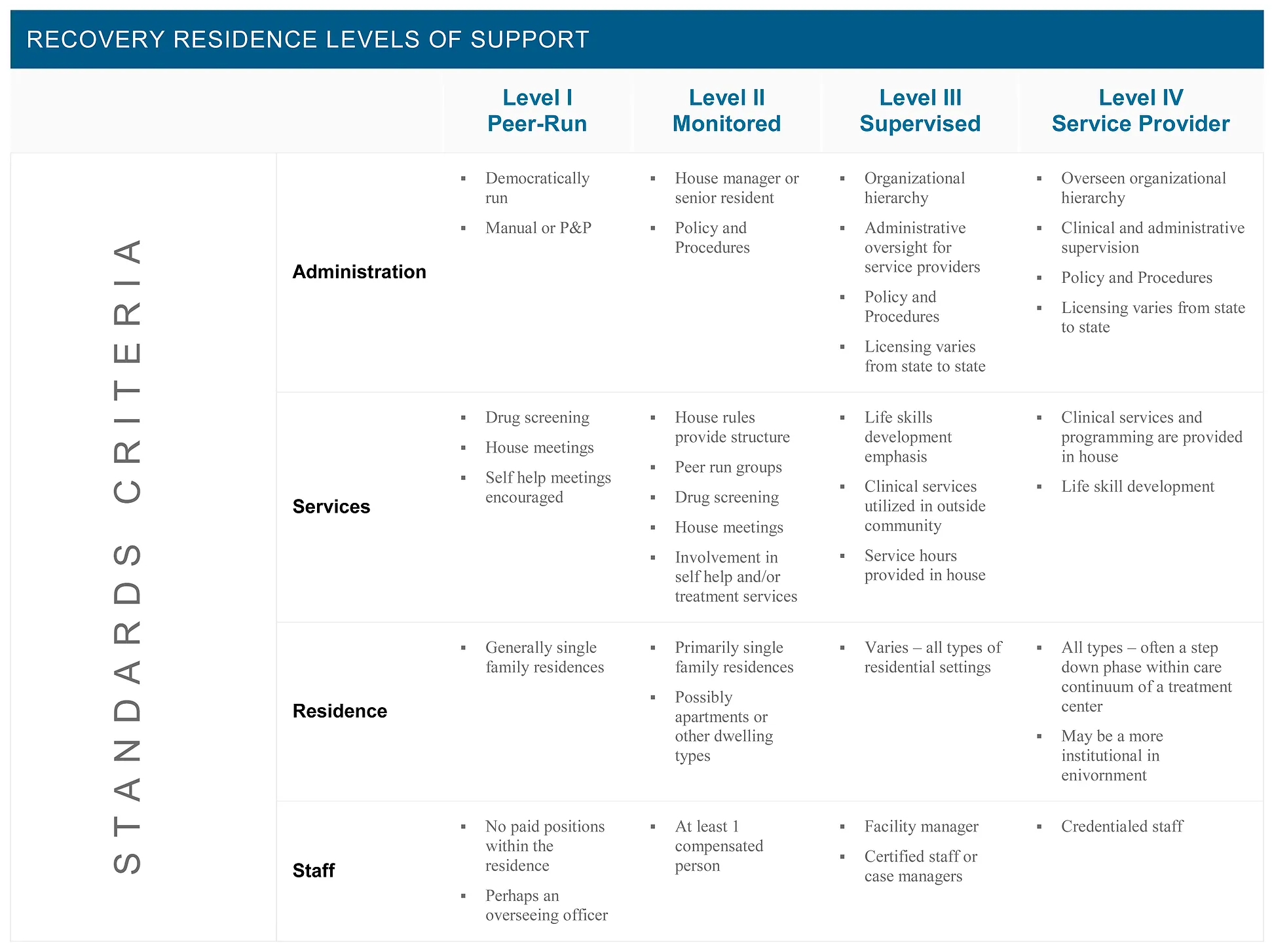
NARR Certification Levels:
TROHN certifies all four NARR levels:
| Level | Description | Staffing | Best For |
|---|---|---|---|
| Level 1: Peer-Run | Democratic, self-governing | No paid staff | Oxford House model, experienced residents |
| Level 2: Monitored | Administrative oversight | House manager or director | Most common for independent operators |
| Level 3: Supervised | 24/7 support available | Paid staff presence | Higher-needs residents, clinical partnerships |
| Level 4: Service Provider | Clinical supervision | Credentialed staff | Treatment organization-operated, intensive support |
Most independent operators pursue Level 2 certification.
Certification Process:
- Review NARR Standards - Study the NARR Standards for your target level
- Prepare Documentation:
- Organizational policies and procedures
- Resident agreements and house rules
- Staff training documentation
- Safety compliance records
- Insurance verification
- Zoning and local compliance documentation
- Submit Application - Apply through TROHN’s certification portal
- Pay Fees:
- Application fee: $500
- Bed fee: $10 per bed
- Document Review and Interviews - TROHN reviews materials and interviews operators
- Site Visit - Inspector visits facility, tours all areas, interviews staff/residents
- Certification Decision - Typically within 2-3 weeks of site visit
- Certification Valid for 2 Years - Renewal required with re-inspection
Timeline: Expect 60-90 days from application to certification.
TROHN Contact:
- Website: https://trohn.org
- Certification Page: https://trohn.org/certification/
Step 6: Create Policies and House Rules
Develop comprehensive policies before accepting your first resident.
Essential Policies:
Sobriety and Drug Testing:
- Zero tolerance drug and alcohol policy
- Random testing schedule (minimum weekly)
- Testing methods and chain of custody
- Consequences for positive tests
- Relapse response protocols
House Rules:
- Curfew and overnight policies
- Visitor rules and hours
- Cleaning and chore responsibilities
- Common area usage
- Noise levels and quiet hours
- Electronics and media policies
- Vehicle and parking rules
Financial Policies:
- Weekly/monthly rent amounts
- Payment due dates and methods
- Late fee structure
- Security deposit requirements
- Refund policies
- Eviction/discharge procedures
Resident Rights and Responsibilities:
- Privacy protections
- Grievance procedures
- Fair housing compliance
- Confidentiality of resident information
- Requirements for program participation
Texas-Specific Considerations:
- Texas heat: Policies around HVAC usage and utility responsibilities
- Hurricane preparedness: Emergency plans for Gulf Coast operations
- Large property sizes: Outdoor area and maintenance responsibilities
- Vehicle-dependent culture: Transportation and parking policies
Step 7: Hire Staff
Staffing requirements depend on your TROHN certification level and operational model.
Common Staff Roles:
| Role | Responsibilities | Texas Pay Range |
|---|---|---|
| House Manager | Day-to-day operations, resident support, rule enforcement | $35,000-50,000/year |
| Assistant Manager | Coverage, resident support, documentation | $28,000-40,000/year |
| Peer Recovery Specialist | Resident mentoring, recovery support | $15-22/hour |
| Administrative Support | Billing, documentation, phone | $32,000-42,000/year |
Texas Certification Options:
While Texas doesn’t require staff certification for sober living homes, these credentials add value:
- Certified Peer Recovery Support Specialist (CPRS) - Texas HHSC certification for peer support workers
- Licensed Chemical Dependency Counselor (LCDC) - For staff providing counseling (triggers licensing requirements)
- NARR Certified Recovery Residence Administrator (CRRA) - National credential for house managers
Hiring Tips:
- Many successful house managers are themselves in long-term recovery
- Background checks are essential for all staff. Some Texas cities may require fingerprint-based criminal history reports for owners, operators, and employees under local boarding home ordinances. Consult a local attorney to confirm what your jurisdiction requires.
- Even where not legally mandated, thorough background screening (including fingerprinting) is strongly recommended for staff working with vulnerable populations. Failure to properly screen staff creates significant liability exposure.
- Consider live-in house managers to reduce costs and increase presence
- Train all staff on fair housing, confidentiality, and emergency procedures
Step 8: Build Your Referral Network
Success in Texas depends on building strong relationships with referral sources.
Priority Referral Sources:
Treatment Centers:
- Residential treatment facilities in your area
- Outpatient programs
- Detox facilities
- Hospital substance abuse programs
Criminal Justice:
- County probation departments
- Parole officers
- Drug courts
- Pre-trial diversion programs
- County jails with reentry programs
Healthcare:
- Hospital emergency departments
- Community mental health centers
- Primary care physicians
- Federally Qualified Health Centers
Community Organizations:
- Recovery community organizations
- Faith-based recovery programs
- Employee assistance programs
- Veterans organizations
Building Relationships:
- Research facilities in your area - Create a list of all treatment centers and referral sources
- Schedule introduction meetings - Meet with discharge planners, case managers, and probation officers
- Provide professional materials - Brochure, business cards, intake requirements
- Offer facility tours - Invite referral sources to see your operation
- Maintain regular contact - Follow up monthly, share success stories (with permission)
- Exceed expectations - Communicate about residents, provide transportation when needed
- Join industry associations - TROHN, local recovery community organizations
Step 9: Set Up Operations
Efficient systems from day one set you up for success.
Management Software:
Modern sober living operations require technology. Our Sober Living App provides:
- Resident admissions processing
- Bed management and occupancy tracking
- Billing and payment processing
- Drug testing result documentation
- Incident reporting and logs
- Housing notes and documentation
- Staff communication tools
Drug Testing Supplies:
- Instant test cups (THC, opioids, benzodiazepines, amphetamines, cocaine minimum)
- Confirmation lab account for contested results
- Secure storage for samples
- Documentation forms
Office Essentials:
- Resident file system (physical or digital)
- Intake paperwork and forms
- Computer and printer
- Secure Wi-Fi network
- Phone line for inquiries
House Supplies:
- Quality mattresses and bedding
- Common area furniture
- Kitchen equipment and dishes
- Cleaning supplies
- First aid kit
- Fire extinguishers
- Smoke and CO detectors
Texas Funding Opportunities
Texas offers significant funding opportunities for recovery housing operators.
State Opioid Settlement Funds
Texas received approximately $1.6 billion in opioid settlement money, distributed over 18 years.
How Texas Distributes Funds:
The Texas Opioid Abatement Fund Council oversees distribution:
- Centralized state control (unlike some states with county-level distribution)
- Competitive grant application process
- Recovery housing is an approved use category
- TROHN certification is typically required for eligibility
Realistic Expectations: These grants are highly competitive. Priority typically goes to established organizations — counties, hospital districts, large nonprofits, and entities with demonstrated track records. New operators without operating history should consider partnering with an established organization to strengthen their applications, or focus on other funding sources while building a track record.
How to Position for Funding:
- Monitor the Texas Comptroller’s grant opportunities page for current deadlines and eligibility criteria
- Sign up for email updates
- Obtain TROHN certification (allow extra time — processing can take longer than the stated 60-90 days)
- Document your outcomes and impact from the start
- Build relationships with your state legislators
- Consider partnering with established entities for joint applications
For current Texas opioid settlement updates, see our Opioid Settlement Funding guide.
Federal Grant Programs
SAMHSA Grants:
- State Opioid Response (SOR) grants flow through HHSC
- Grants for Benefit of Homeless Individuals (GBHI)
- Recovery Community Services Program
HUD Programs:
- Recovery Housing Program
- Continuum of Care grants
- Community Development Block Grants
Search Grants.gov for current opportunities, filtering by “Housing,” “Substance Abuse,” and Texas.
Foundation and Private Funding
- Robert Wood Johnson Foundation
- Open Society Foundations
- Community foundations in major Texas cities
- Healthcare system community benefit programs
- Treatment center partnership arrangements
Texas Market Considerations
Cost of Living by Region
| Region | Cost Index | Housing | Utilities | Best For |
|---|---|---|---|---|
| Houston Metro | Average | Moderate | High (cooling) | Large market, diversity |
| Dallas-Fort Worth | Above Average | Higher | Moderate | Strong economy, suburbs |
| Austin Metro | High | Very High | Moderate | Premium operations |
| San Antonio | Below Average | Affordable | Moderate | Lower startup costs |
| Rio Grande Valley | Low | Very Affordable | Moderate | Underserved, bilingual |
| East Texas | Low | Affordable | Lower | Rural, underserved |
| Panhandle | Low | Affordable | Variable | Underserved, smaller market |
Insurance Requirements
Essential Coverage for Texas:
| Coverage Type | Recommended Amount | Annual Cost |
|---|---|---|
| General Liability | $1-2 million | $4,000-8,000 |
| Property Insurance | Replacement value | $2,000-5,000 |
| Professional Liability | $500K-1 million | $2,000-4,000 |
| Workers’ Compensation | State minimum | $2,000-5,000 (if employees) |
| Umbrella Policy | $1-5 million | $1,000-3,000 |
Note: Insurance premiums for recovery residences have increased significantly in recent years. The estimates above are approximate — request quotes from multiple carriers with recovery housing experience to get accurate pricing for your specific situation.
Texas-Specific Insurance Considerations:
- Hurricane and flood coverage essential for Gulf Coast properties
- Named storm deductibles in coastal counties
- Hail damage coverage for North Texas
- Consider business interruption coverage
Specialized Providers:
Look for insurance companies with recovery housing experience:
- The Hartford
- Markel Corporation
- Philadelphia Insurance Companies
- Regional carriers with behavioral health expertise
Weather Considerations
Heat Management:
- Air conditioning is essential (April-October)
- Budget for higher utility costs ($200-400/month in summer)
- Ensure HVAC systems are properly maintained
- Consider Energy Star appliances for cost savings
Hurricane Preparedness (Gulf Coast):
- Develop evacuation plans
- Maintain emergency supply kit
- Board-up or shutter plans for properties
- Resident communication protocols
- Business interruption insurance
Severe Weather:
- Tornado safety plans for all properties
- Designated shelter areas
- Weather alert systems
- Resident training on severe weather protocols
Common Challenges in Texas
NIMBYism and Community Opposition
Some Texas neighborhoods resist recovery housing. Proactive strategies:
Prevention:
- Choose properties carefully (avoid contentious neighborhoods)
- Introduce yourself to neighbors early
- Maintain impeccable property appearance
- Address concerns immediately
- Enforce strict visitor and noise policies
If Opposition Occurs:
- Document all interactions
- Reference Fair Housing Act protections
- Contact Texas Fair Housing Action
- Consult an attorney specializing in fair housing
- Engage TROHN for support and resources
- Consider media engagement carefully
Competition from Unethical Operators
Texas’s lack of state licensing means some operators cut corners. Differentiate yourself:
- Pursue and maintain TROHN certification
- Maintain transparent operations
- Document outcomes and share success stories
- Build strong referral relationships based on quality
- Report patient brokering and fraud to authorities
Staffing Challenges
Finding quality staff in Texas’s strong job market can be difficult:
- Offer competitive wages (reference ranges above)
- Consider housing as part of compensation for live-in managers
- Partner with recovery community organizations for recruitment
- Develop internal training programs
- Create advancement opportunities
Operator Scenario: Houston Recovery Residence
Note: This is a hypothetical composite scenario for illustrative purposes only. It represents a best-case outcome for an operator with significant prior experience and established relationships. Your results will vary based on your market, experience, referral network, and many other factors.
Background: Former treatment center counselor with existing referral relationships opened 8-bed facility in suburban Houston.
Investment: $85,000 initial capital (lease, renovations, furniture, operating capital)
Best-Case Results After 18 Months:
- 94% average occupancy (note: new homes without established referral networks commonly experience 40-60% vacancy in the first year)
- $18,000 average monthly revenue at stabilized occupancy
- TROHN Level 2 certified
- 65% of referrals from treatment centers
- 20% from court/probation
- 15% from families and self-referrals
Key Success Factors:
- Operator had existing relationships with treatment centers before opening — this is the single most important factor
- TROHN certification completed before opening
- Live-in house manager reduces overhead
- Technology platform for efficient operations
- Active involvement in Houston recovery community
Realistic Expectations for New Operators: Plan for 6-12 months of below-capacity occupancy while you build your referral network. Ensure you have sufficient operating capital to cover expenses during this ramp-up period.
Texas Resources
TROHN (Texas Recovery Oriented Housing Network)
Website: https://trohn.org
Certification: https://trohn.org/certification/
NARR Affiliate Page: https://narronline.org/affiliate/texas-recovery-oriented-housing-network/
State Agencies
Texas Health and Human Services Commission (HHSC): https://www.hhs.texas.gov
Texas Comptroller - Opioid Abatement Fund Council: https://comptroller.texas.gov/programs/opioid-council/
Texas Secretary of State (Business Formation): https://www.sos.texas.gov
Legal and Fair Housing Resources
Texas Fair Housing Action: https://texasfairhousing.org/
HUD Fort Worth Regional Office: Phone: (817) 978-5900
Texas RioGrande Legal Aid: Free legal services for qualifying organizations
Industry Associations
National Alliance for Recovery Residences (NARR): https://narronline.org
Texas Association of Addiction Professionals (TAAP): https://www.taap.org
Your Next Steps
Starting a sober living home in Texas offers opportunities for both financial sustainability and meaningful community impact. Growing demand for recovery housing and the availability of TROHN certification create a foundation for dedicated operators.
Immediate Action Items:
- Retain a qualified attorney - Consult with a lawyer experienced in Texas land use, fair housing, and recovery housing regulations in your target city. This is your most important first step.
- Research Your Target Market - Visit existing facilities, meet with treatment providers, assess competition in your area
- Determine Local Regulatory Requirements - Work with your attorney to identify all city, county, and state requirements for your specific jurisdiction
- Develop Your Business Plan - Use the cost estimates in this guide as starting points, but verify all figures for your specific market
- Form Your Business Entity - LLC formation through Texas Secretary of State
- Begin TROHN Certification Process - Review standards and prepare documentation
- Start Property Search - Work with agents familiar with recovery housing and local zoning
Long-term Success Strategies:
- Build deep relationships with treatment providers and courts
- Invest in quality management systems and staff training
- Maintain TROHN certification and compliance excellence
- Focus on outcomes and resident success
- Plan for expansion once your first facility stabilizes
Texas needs more quality recovery housing. Position yourself now to capture this opportunity while making a lasting difference in people’s lives.
How Sober Living App Can Help You Succeed
At Sober Living App, we’ve helped hundreds of operators across Texas and nationwide build successful recovery housing businesses. Our comprehensive management platform handles complex operational details so you can focus on creating supportive environments for recovery.
Our Platform Includes:
- Comprehensive Admissions Management - Streamline intake with digital applications, document collection, and resident onboarding workflows
- Intelligent Bed Management - Track occupancy, waiting lists, and room assignments in real-time from any device
- Automated Billing and Operations - Handle rent collection, late fees, and financial reporting with integrated payment processing
- Housing Documentation - Maintain detailed records for TROHN certification and inspections
- Resident and Staff Communication - Keep everyone connected with announcements, messaging, and incident reporting
Every feature is designed specifically for recovery housing operations, with input from successful operators across Texas. Our cloud-based system means you can manage your facilities from anywhere while keeping all information secure and accessible.
Ready to Get Started?
Claim your free trial today and see why Texas’s most successful sober living operators choose Sober Living App to power their operations.
Join the growing community of recovery housing providers who’ve discovered that the right technology platform makes the difference between struggling to keep up and building a thriving business that truly serves the recovery community.
Manage your homes more efficiently
From admissions to discharge, Sober Living App streamlines every aspect of running recovery residences.
Related Articles
Sober Living Home Startup Guide
Sober living home startup guide with foundational steps for opening your first recovery residence. Covers business planning, property selection, and operations.

Texas NARR State Affiliate (TROHN) | Complete Guide
Texas Recovery Oriented Housing Network (TROHN) - Texas's NARR affiliate for recovery housing certification. Requirements, levels, benefits, and how to get certified.

Grants for Recovery Homes: Funding Guide [2026]
Apply for $50K-$500K federal grants (SAMHSA, HUD, DOJ), state opioid settlement funds, and foundation grants for recovery housing. Step-by-step application guide.