
How to Open a Sober Living Home in Mississippi [2026]
Complete guide to opening a sober living home in Mississippi. No state certification required — regulations, startup costs, funding opportunities, and market analysis.
Legal Disclaimer
This article provides general information for educational purposes only. It is not legal, financial, or compliance advice. Recovery housing regulations vary by state, county, and municipality. You must consult with a qualified local attorney and your municipality's code enforcement office to confirm all requirements at every level of jurisdiction. Regulations change frequently — always verify current requirements directly with relevant government agencies.
Opening a sober living home in Mississippi requires no state license or mandatory certification, and the state offers some of the most affordable startup costs in the nation. Growing demand for recovery housing and available opioid settlement funding make Mississippi an emerging opportunity for recovery residence operators in 2026.
Mississippi has been hit hard by the opioid crisis. Overdose deaths have risen steadily, with the state ranking among the top in the Southeast for opioid-related fatalities per capita. At the same time, Mississippi has a limited supply of quality recovery housing, creating significant unmet demand. For operators willing to build quality programs in an underserved market, the combination of low barriers to entry, affordable real estate, and growing need makes Mississippi one of the most accessible states to launch a sober living operation.
What this guide covers:
- Mississippi regulations and why no state license is needed
- NARR certification status and voluntary credentialing options
- Step-by-step process from business formation to opening day
- Startup costs by Mississippi market (Jackson, Gulfport-Biloxi, Hattiesburg, Tupelo)
- Opioid settlement funding and federal grant access
- Zoning, Fair Housing protections, and NIMBYism strategies
- Building referral networks with treatment centers and courts
Whether you are a recovery professional looking to expand services or an entrepreneur committed to serving the recovery community, this guide gives you the complete playbook for launching and operating a sober living home in Mississippi.

Mississippi Regulatory Overview
Mississippi maintains one of the most operator-friendly regulatory environments in the nation for recovery housing. The state imposes no mandatory certification or licensing requirements on sober living homes, and there are no immediate signs that the legislature plans to change this approach.
No State License Required at the State Level

Mississippi does not have a state-level certification program for sober living homes, regardless of the size, scope, or nature of the facility. All sober living homes — residential homes that do not offer treatment or other medical care — are exempt from state regulations that do not also apply to typical residential housing. This is a significant advantage compared to states like California or New Jersey, which have varying levels of mandatory oversight.
However, cities and counties may have their own group home, boarding home, or other local ordinances that impose additional requirements. You must verify all local regulations with your municipality and consult a qualified local attorney before opening.
What you can provide without licensing:
- Safe, substance-free housing
- Peer support and accountability structures
- House meetings, curfews, and structured daily routines
- Drug and alcohol testing
- Transportation to external treatment, employment, and recovery meetings
- Basic life skills coaching and recovery-oriented community living
- Connection to community recovery resources (AA, NA, Celebrate Recovery)
What triggers licensing requirements:
Mississippi does require certification for certain categories of facilities. You will need certification from the Mississippi Department of Mental Health (DMH) if you operate:
- A community-based agency that offers addiction treatment
- A community mental health center that provides addiction treatment services
- An organization that accepts grants from the Mississippi Department of Mental Health
- An addiction treatment facility that accepts Medicaid reimbursement
The distinction is clear: housing and peer support require no license. Clinical treatment services, counseling, and medication management trigger state oversight through DMH.
You may be surprised to learn that Mississippi does not even require certification for most standalone addiction treatment centers. The exceptions listed above apply to specific organizational types. At the state level, the regulatory burden for sober living home operators is among the lowest in the country. However, operators should not assume this means there are no regulations — local jurisdictions (cities, counties, and municipalities) may impose their own zoning, occupancy, or licensing requirements that apply to group living arrangements. Always research your specific locality’s rules.
Sober Living Homes Are Not “Chemical Dependency Units” or “Personal Care Homes”
An important legal distinction in Mississippi: sober living homes are not classified as chemical dependency units or personal care homes. These facility types are held to significantly higher regulatory standards.
Sober living homes are not chemical dependency units because they do not provide any form of addiction treatment services on-site. They are purely residential facilities protected by ADA and Fair Housing Act laws designed to ensure equal access to housing regardless of disability.
Sober living homes are also not personal care homes. Personal care homes, sometimes called “assisted living” facilities, provide assistance with activities of daily living (ADLs) such as bathing, walking, feeding, grooming, and dressing. Sober living homes do not provide these services.
Basic Inspection Requirements
According to the Mental Health & Addiction Certification Board of Oregon’s “[National Overview of Recovery Housing Accreditation Legislation and Licensing](https://mhacbo.org/media/NATIONAL. OVERVIEW. RECOVERY. HOUSING. January.2020.pdf),” Mississippi sober living homes must address a few basic requirements before opening:
- Basic congregate living inspection from local code enforcement
- Proof of Housing Quality Standards (HQS) inspection — learn more about HQS requirements
- Proof of annual fire inspection — order through your local fire department
These are standard residential safety inspections, not behavioral health reviews. They verify fire safety, building code compliance, and habitability — the same standards applied to any group residential setting.
Local Zoning and Fair Housing
Mississippi sober living homes are protected under the federal Fair Housing Act. People in recovery from substance use disorders are considered disabled under federal law, which means:
- Cities and counties cannot zone out recovery residences from residential areas
- Sober living homes must receive the same treatment as any family residence
- Special use permits cannot be imposed if they are not required of other families
- Spacing requirements between recovery homes may be challenged as discriminatory
Many Mississippi cities allow 6 or fewer unrelated adults to live together in single-family residential zones without triggering additional permitting requirements, but this threshold varies by municipality — some jurisdictions set lower limits or impose additional requirements on group living arrangements. Always verify the specific occupancy rules in your city or county. Keeping resident counts at or below your municipality’s threshold simplifies zoning compliance considerably.
NARR Certification in Mississippi
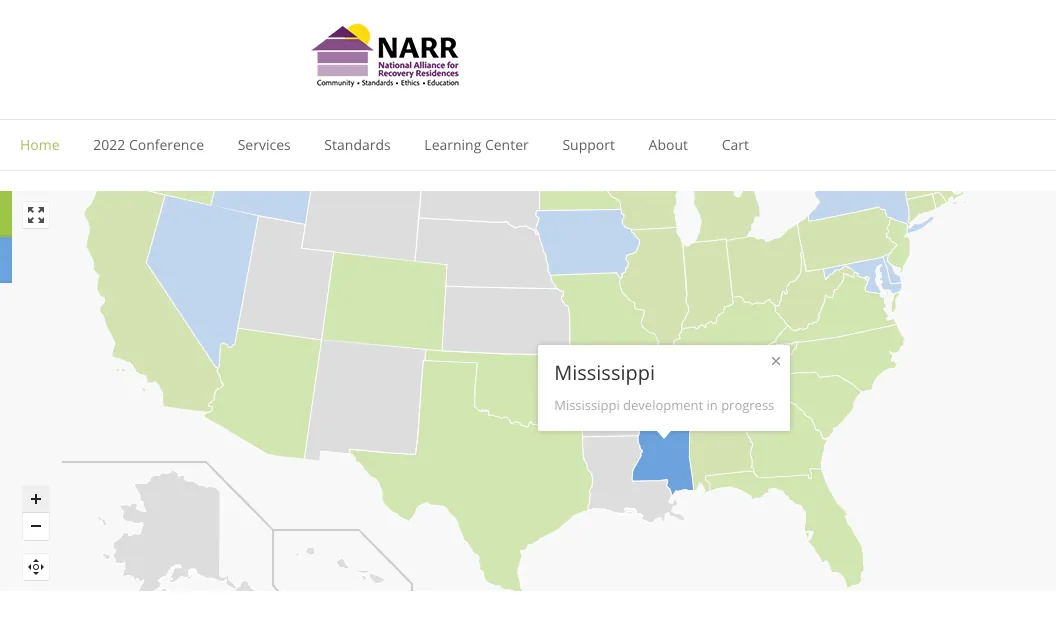
The National Alliance for Recovery Residences (NARR) establishes quality standards for recovery housing nationwide through a network of state affiliates. Mississippi’s NARR affiliate status has been listed as “development in progress” on the NARR website. This means community members in Mississippi have been working with NARR to form a state affiliate organization, but the process has not yet reached full operational status.
For the latest information on Mississippi’s NARR affiliate progress, see our Mississippi NARR State Affiliate guide, which tracks developments as they occur.
Why NARR Certification Still Matters
Even without a fully operational state affiliate, Mississippi operators should understand NARR standards and work toward meeting them. Here is why:
Credibility and referrals. Treatment centers, courts, and referral partners increasingly look for NARR-aligned homes. Meeting NARR Level 2 or Level 3 standards — even without formal state certification — signals professionalism and quality to referral partners who know the standards.
Future funding eligibility. Federal grant programs, including SAMHSA and HUD recovery housing grants, increasingly prioritize NARR-certified or NARR-aligned homes. When Mississippi’s affiliate becomes fully operational, operators already meeting the standards will be first in line for certification and the funding it unlocks.
Resident trust. Families seeking recovery housing for loved ones increasingly research NARR standards online. Marketing your home as meeting NARR standards — even pending formal certification — builds trust with prospective residents and their families.
Liability protection. Operating according to documented, nationally recognized standards provides a stronger legal position if disputes arise with residents, neighbors, or local government.
NARR Certification Levels
NARR defines four levels of recovery housing support. Understanding these levels helps you design your operation from the start:
| Level | Description | Staffing | Best For |
|---|---|---|---|
| Level 1: Peer-Run | Democratic, self-governing | No paid staff | Oxford House model, experienced residents |
| Level 2: Monitored | Administrative oversight | House manager or director | Most common for independent operators |
| Level 3: Supervised | Onsite support available | Paid staff presence | Higher-needs residents, clinical partnerships |
| Level 4: Service Provider | Clinical coordination | Credentialed staff | Treatment-organization-operated homes |
Most independent Mississippi operators should target Level 2 standards as their baseline. This level requires a house manager or director who provides administrative oversight, documented policies and procedures, and structured house rules — but does not require 24/7 staff coverage or clinical credentials.
For a comprehensive walkthrough of the NARR certification process, see our NARR Certification Guide.
What to Do Now
While waiting for Mississippi’s NARR affiliate to become fully operational:
- Study NARR standards at narronline.org/resources
- Develop policies and documentation that meet Level 2 requirements
- Contact NARR directly to ask about Mississippi’s affiliate timeline
- Connect with neighboring state affiliates (Alabama, Tennessee, Louisiana) for guidance and networking
- Document your compliance efforts so you are ready to apply as soon as the affiliate opens
Step-by-Step: Opening a Sober Living Home in Mississippi
Step 1: Form Your Business Entity
Register your business with the Mississippi Secretary of State. Most sober living operators choose one of these structures:
| Structure | Pros | Cons | Best For |
|---|---|---|---|
| LLC | Liability protection, flexible taxation, simple formation | Self-employment taxes | Most operators |
| 501(c)(3) Non-Profit | Grant eligibility, tax exemption, donation deductibility | Complex setup, board governance requirements | Mission-driven, grant-focused operations |
| S-Corp | Potential tax savings, liability protection | More complex compliance, payroll requirements | Higher-revenue operators |
Formation steps:
- Search the Mississippi Secretary of State business database for name availability
- File Certificate of Formation with the Secretary of State (online filing available)
- Obtain an EIN from the IRS at irs.gov (free, required for business banking)
- Open a dedicated business bank account — never mix personal and business finances
- Set up basic accounting (QuickBooks, Wave, or a local bookkeeper)
- Consult a Mississippi business attorney for entity formation and operating agreements ($300-$1,000)
Step 2: Secure Funding and Assess Startup Capital
Mississippi’s low cost of living makes startup capital requirements among the lowest in the nation. See the detailed cost section below for market-by-market breakdowns.
Key funding sources include personal savings, SBA microloans, SAMHSA grants, HUD Recovery Housing Program funds, and state opioid settlement allocations through the Mississippi Department of Mental Health. For comprehensive strategies, see our Grants for Recovery Homes guide.
Step 3: Choose Your Mississippi Market
Mississippi offers several viable markets for sober living operations. Each has distinct characteristics:
Jackson Metro (population ~580,000): The state capital and largest metro area. Jackson has the highest concentration of treatment centers, hospitals, courts, and referral sources. Real estate is affordable by national standards but is the most expensive Mississippi market. The metro area’s diverse healthcare infrastructure creates steady demand for step-down recovery housing.
Gulfport-Biloxi (population ~400,000): The Gulf Coast has a larger combined population base than many realize and significant recovery housing need. The casino and hospitality industry creates unique substance use patterns. Proximity to coastal tourism means seasonal demand fluctuations. Hurricane risk requires insurance planning.
Hattiesburg (population ~150,000): A mid-size city with two universities (University of Southern Mississippi and William Carey University), regional medical centers, and growing treatment infrastructure. Affordable real estate and a stable community make it attractive for first-time operators.
Tupelo (population ~95,000): Northeast Mississippi’s largest city. Treatment infrastructure exists but recovery housing supply is limited. 1st Step Sober Living in Tupelo has demonstrated demand in the market despite facing NIMBYism challenges.
Oxford (population ~75,000): Home to the University of Mississippi, Oxford presents a unique market with both college-age and general community demand. Oxford House models have operated here successfully, though they have also faced community opposition.
Step 4: Find and Secure a Property
Mississippi’s real estate market is exceptionally affordable. Look for properties with these characteristics:
- 4-6 bedrooms for optimal occupancy and zoning simplicity
- Multiple bathrooms (aim for 1 per 3-4 residents)
- Common areas large enough for house meetings
- Residential neighborhood with access to employment, transit, and services
- Proximity to treatment centers, recovery meetings, and medical facilities
- Adequate parking (essential in Mississippi where public transit is limited)
Lease vs. purchase: Mississippi’s low real estate prices make purchasing viable even for first-time operators. A suitable 4-bedroom home in many Mississippi markets can be purchased for $80,000-$150,000, with monthly mortgage payments well below rental rates in most other states. Leasing remains a lower-risk option for testing a market before committing capital.
Step 5: Complete Required Inspections
Schedule and pass the three required inspections:
- Congregate living inspection — Contact your local code enforcement office
- Housing Quality Standards (HQS) inspection — Verifies habitability standards
- Fire inspection — Contact your local fire department to schedule
Address any deficiencies identified during inspections before accepting residents. Common issues include missing smoke detectors, inadequate egress windows, and fire extinguisher placement.
Step 6: Develop Policies and House Rules
Create comprehensive written policies covering:
- Sobriety requirements: Zero-tolerance policy, drug and alcohol testing frequency and methods, consequences for positive tests, relapse response protocols
- House rules: Curfews, visitor policies, chore assignments, quiet hours, common area usage, electronics policies
- Financial policies: Rent amounts, payment schedules, late fees, security deposits, refund and discharge procedures
- Resident rights: Privacy protections, grievance procedures, Fair Housing compliance, confidentiality of resident information
- Emergency procedures: Medical emergencies, severe weather (tornadoes and hurricanes for Gulf Coast locations), fire evacuation
Step 7: Obtain Insurance
Essential coverage for Mississippi sober living homes:
| Coverage Type | Recommended Amount | Estimated Annual Cost |
|---|---|---|
| General Liability | $1-2 million | $1,500-$3,500 |
| Property Insurance | Replacement value | $800-$2,500 |
| Professional Liability | $500K-$1 million | $800-$2,000 |
| Workers’ Compensation | State minimum | $1,500-$3,500 (if employees) |
Mississippi-specific considerations: Gulf Coast properties (Gulfport, Biloxi, Pascagoula) require hurricane and flood coverage. Named storm deductibles apply in coastal counties. Flood insurance through FEMA’s National Flood Insurance Program may be required depending on location.
Step 8: Build Your Referral Network
Recovery housing success depends on consistent referrals. Priority contacts in Mississippi:
- Treatment centers: Residential treatment, outpatient programs, and detox facilities in your area
- Courts and probation: Drug courts, county probation departments, and pre-trial diversion programs
- Hospitals and health systems: Emergency departments, behavioral health units, and community mental health centers operated through the Mississippi Department of Mental Health (DMH)
- Recovery community organizations: AA, NA, Celebrate Recovery, and local recovery community organizations
- Faith-based organizations: Mississippi has a strong faith community with many churches supporting recovery ministry
Step 9: Set Up Operations and Technology
Efficient systems from day one prevent operational headaches. Set up:
- Management software for admissions, billing, bed tracking, and documentation
- Drug testing supplies — instant test cups covering at minimum THC, opioids, benzodiazepines, amphetamines, and cocaine
- Resident file systems — digital or physical records for intake paperwork, testing results, and incident reports
- Communication systems — phone line for inquiries, staff communication tools, resident announcements
Step 10: Open and Begin Accepting Residents
With inspections passed, policies documented, insurance secured, and referral relationships established, you are ready to accept your first residents. Start with a manageable census — even 2-3 residents — and build gradually as you refine operations and establish your reputation in the community.
Mississippi Startup Costs and Revenue
Mississippi offers the lowest startup costs of any state in the country for sober living operators. The combination of affordable real estate, low cost of living, and minimal regulatory fees keeps the barrier to entry exceptionally low.
Startup Cost Breakdown
| Expense Category | Low Estimate | High Estimate | Notes |
|---|---|---|---|
| Property (first/last/deposit or down payment) | $1,500 | $15,000 | Leasing vs. purchasing |
| Renovations and safety upgrades | $1,000 | $8,000 | Fire safety, basic repairs |
| Furniture, beds, and essentials | $2,000 | $8,000 | Quality mattresses, common area |
| Insurance (first year) | $2,000 | $6,000 | Liability, property |
| Legal and professional fees | $500 | $3,000 | Entity formation, contracts |
| Marketing and technology | $500 | $2,000 | Website, management software |
| Operating capital (3 months) | $3,000 | $12,000 | Cover costs before break-even |
| Total | $10,500 | $54,000 | Varies significantly by market |
For operators leasing a modest home in a smaller Mississippi market (Hattiesburg, Tupelo, Meridian), total startup costs can realistically fall in the $10,000-$20,000 range. Jackson and Gulf Coast markets will be higher but still far below national averages.
Property Costs by Market
| Market | Avg Monthly Rent (4-5 BR) | Purchase Price Range | Notes |
|---|---|---|---|
| Jackson | $1,000-$1,800 | $100,000-$200,000 | Largest market, most treatment infrastructure |
| Gulfport-Biloxi | $1,100-$1,900 | $120,000-$220,000 | Gulf Coast, hurricane insurance needed |
| Hattiesburg | $800-$1,400 | $80,000-$160,000 | University town, stable community |
| Tupelo | $700-$1,200 | $75,000-$150,000 | Northeast MS, growing market |
| Oxford | $900-$1,500 | $100,000-$180,000 | College town, higher demand |
| Meridian | $600-$1,000 | $50,000-$120,000 | Affordable, underserved |
| Smaller Cities | $500-$900 | $40,000-$100,000 | Very low cost, limited referral sources |
Revenue Projections
Mississippi’s lower cost of living means resident fees are lower than national averages, but so are operating expenses. Typical pricing:
| Revenue Component | Monthly Range | Notes |
|---|---|---|
| Resident fee (per person) | $400-$800 | Varies by market and amenities |
| Application/intake fee | $50-$150 | One-time per resident |
| Drug testing fee | $25-$50 | Per test, if charged separately |
Example: 6-bed home in Hattiesburg
- Monthly resident fees: 6 residents x $550 = $3,300
- Monthly expenses (rent, utilities, insurance, supplies, staffing): approximately $2,200-$2,800
- Monthly net income: $500-$1,100
- Annual net income: $6,000-$13,200
Margins improve significantly at higher occupancy and with multiple homes. Established operators running 2-3 homes with 85%+ occupancy can generate meaningful income while keeping resident fees accessible. A note on occupancy assumptions: New operators should realistically expect 40–60% occupancy in their first year as they build referral relationships and community reputation. Plan your finances conservatively around lower initial occupancy rather than these mature-operation figures.
Funding for Mississippi Recovery Homes
Mississippi operators have access to several funding streams that can offset startup costs, support operations, and enable expansion. Important caveat: Most government grants are highly competitive and primarily target established 501(c)(3) organizations with documented operational history, outcome data, and financial audits. First-time operators should plan to self-fund their startup and early operations, and treat grant funding as a longer-term goal rather than an initial funding source.
Mississippi Opioid Settlement Funds
Mississippi has received opioid settlement allocations distributed through the Mississippi Department of Mental Health and the state Attorney General’s office. Recovery housing is recognized as an approved use of opioid settlement dollars under the national settlement frameworks.
How to position for funding:
- Monitor the Mississippi Department of Mental Health website for grant announcements
- Contact DMH directly to inquire about current recovery housing funding opportunities
- Build relationships with your state legislators who serve on health and human services committees
- Document your operational outcomes (occupancy rates, resident employment, sobriety maintenance)
- Work toward NARR-aligned standards to strengthen grant applications
Federal Grant Programs
SAMHSA Grants:
- State Opioid Response (SOR) grants flow through the Mississippi Department of Mental Health
- Grants for the Benefit of Homeless Individuals (GBHI)
- Recovery Community Services Program
- Search grants.gov for current opportunities filtering by “Housing,” “Substance Abuse,” and Mississippi
HUD Recovery Housing Program:
- Administered at the state level through the Mississippi Home Corporation
- Provides funding for transitional and recovery housing
- Contact the Mississippi Home Corporation for application cycles
Other Federal Sources:
- DOJ Second Chance Act grants for facilities serving people leaving incarceration
- USDA Rural Development grants for operators in rural Mississippi communities
- VA per diem programs for recovery homes serving veterans
Foundation and Private Funding
- Community foundations in Jackson, Gulf Coast, and other Mississippi regions
- Healthcare system community benefit programs from Baptist Memorial, Merit Health, and Singing River health systems
- Faith-based foundation grants (Mississippi’s strong faith community supports recovery initiatives)
- Treatment center partnership arrangements (referral guarantees in exchange for startup support)
For a comprehensive guide to funding strategies, see our Grants for Recovery Homes guide.
Mississippi Recovery Housing Market
Mississippi’s recovery housing market is characterized by high unmet demand and limited supply. Several factors make the current environment favorable for new operators.
Demand Drivers
Opioid crisis impact. Mississippi has experienced significant increases in opioid-related overdose deaths, mirroring national trends. Fentanyl has entered the state’s drug supply, driving up overdose rates and increasing the urgency for recovery support services including housing. The Mississippi State Department of Health tracks overdose data and has reported year-over-year increases.
Treatment capacity growth. As Mississippi expands treatment center capacity — both residential and outpatient — the downstream demand for step-down recovery housing grows proportionally. Every residential treatment discharge represents a potential sober living referral.
Limited existing supply. Compared to states like Florida, California, or Texas, Mississippi has very few established sober living home operators. This limited competition means new operators face less difficulty establishing referral relationships and filling beds.
Court and probation demand. Mississippi drug courts and probation departments need quality recovery housing placements. Operators who build relationships with the criminal justice system can establish consistent referral pipelines.
Underserved Populations
Mississippi has particular unmet need among:
- Rural communities where recovery housing is nonexistent
- Veterans (Mississippi has a significant veteran population)
- Women in recovery (most existing homes serve men)
- People involved in the criminal justice system
- Spanish-speaking communities along the Gulf Coast
Competition Landscape
Mississippi’s recovery housing market has low competition across nearly all geographies. The state’s Oxford House network provides some peer-run (Level 1) capacity, but there are very few independently operated Level 2-4 homes. Operators who invest in quality, pursue NARR-aligned standards, and build referral relationships will find themselves well-positioned in a market with more demand than supply.
Compliance and Best Practices
Navigating NIMBYism
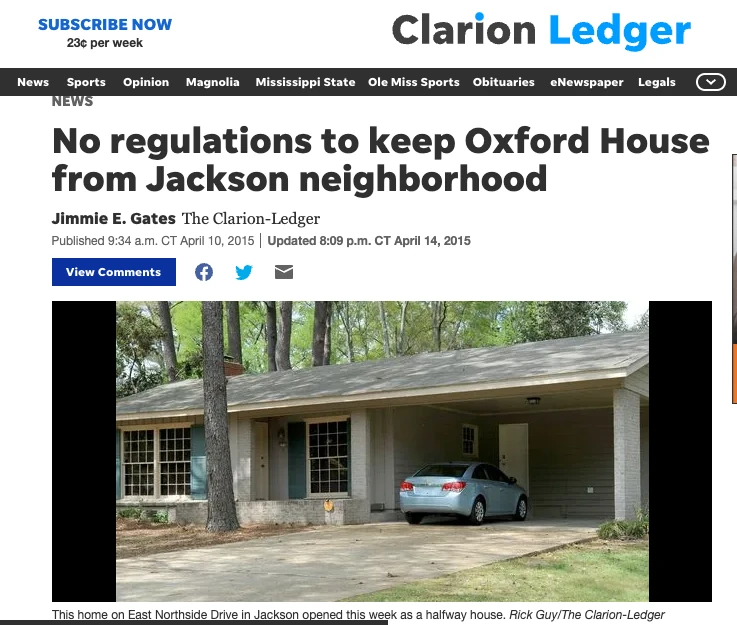
NIMBYism (“Not In My Backyard”) remains a real challenge for Mississippi sober living operators, despite federal Fair Housing protections. 1st Step Sober Living in Tupelo faced opposition when it opened an eight-bed facility in a residential neighborhood. An Oxford House in Jackson faced strong community resistance when renting from a private landlord. In both cases, the homes continued operating legally, but the opposition created additional scrutiny.
Prevention strategies:
- Introduce yourself to neighbors before opening and provide your direct contact information
- Maintain impeccable property appearance — lawn care, exterior maintenance, no visible clutter
- Enforce strict quiet hours, visitor policies, and parking rules
- Address any legitimate neighbor concerns immediately and professionally
- Keep resident count at or below your municipality’s occupancy threshold for single-family residential zoning (often 6 or fewer unrelated adults, but this varies — verify locally)
If opposition occurs:
- Document all communications with neighbors and city officials
- Reference Fair Housing Act protections — people in recovery are protected under federal disability law
- Contact the HUD regional office for fair housing assistance
- Consult an attorney specializing in fair housing law
- Engage your state legislators if local government overreaches
Operational Best Practices
Operators who follow these practices build sustainable, reputable programs:
- Document everything. Maintain written records of drug tests, house meetings, incident reports, and resident agreements. This protects you legally and supports future certification applications.
- Collect outcomes data. Track resident length of stay, employment rates, sobriety maintenance, and successful transitions. This data strengthens grant applications and referral relationships.
- Invest in staff training. Even if Mississippi does not require it, train house managers on crisis response, trauma-informed care, Fair Housing compliance, and de-escalation techniques.
- Stay current on regulation changes. National trends suggest more states will adopt recovery housing oversight in coming years. Mississippi operators who already meet NARR standards will be ahead of any future regulatory changes.
- Join professional networks. Connect with NARR, neighboring state affiliates, and national operator communities to share best practices and stay informed.
For a comprehensive overview of sober living home licensing requirements across all 50 states, see our national guide.
How Sober Living App Helps Mississippi Operators
Managing a sober living home involves complex day-to-day operations — admissions, billing, drug testing documentation, resident communication, and compliance tracking. Sober Living App provides a purpose-built management platform designed specifically for recovery housing operators.
Our platform includes:
- Admissions management — Streamline intake with digital applications and document collection
- Bed management — Track occupancy, waitlists, and room assignments in real time
- Billing and rent collection — Automate payment processing, late fees, and financial reporting
- Housing notes and documentation — Maintain detailed records that support NARR certification readiness
- Staff and resident communication — Announcements, messaging, and incident reporting from any device
Every feature is built with input from recovery housing operators nationwide, including those in markets similar to Mississippi where lean operations and affordable technology matter most.
Ready to get started? Start your free trial today and see why recovery housing operators across the country trust Sober Living App to run their homes more efficiently and more professionally.
Frequently Asked Questions
Do I need a license to open a sober living home in Mississippi?
Mississippi does not require a specific state license for basic sober living homes at the state level. However, cities and counties may impose their own local requirements — including group home, boarding home, or zoning ordinances — so you must verify all applicable local regulations with your municipality. Voluntary NARR certification through the state affiliate is recommended for credibility and funding access. The Mississippi Department of Mental Health oversees behavioral health services. Consult a qualified local attorney before opening.
How much does it cost to start a sober living home in Mississippi?
Mississippi has some of the lowest startup costs in the nation, typically $5,000-$20,000. Very affordable real estate across the state keeps entry barriers low. Jackson is the most expensive market, while smaller cities offer extremely affordable options.
What funding is available for Mississippi sober living homes?
Mississippi operators can access SAMHSA grants, HUD Recovery Housing Program funds, and state opioid settlement allocations through the Mississippi Department of Mental Health. These grants are highly competitive and primarily target established 501(c)(3) organizations with documented track records. New operators should plan to self-fund initially. Contact DMH for current state-specific funding opportunities.
What are the best markets for sober living in Mississippi?
Jackson, Gulfport-Biloxi, Hattiesburg, Tupelo, and Oxford all have demand. The Gulf Coast area (Gulfport-Biloxi) has a larger population base with significant recovery housing need. College towns like Oxford and Starkville also present opportunity.
Why open a sober living home in Mississippi?
Mississippi offers the lowest startup costs in the country, no mandatory certification at the state level, growing demand from opioid crisis impact, and minimal competition from established operators. The low cost of living allows accessible resident fees while maintaining margins. Note that local municipalities may have their own requirements, so always verify local regulations before opening.
Manage your homes more efficiently
From admissions to discharge, Sober Living App streamlines every aspect of running recovery residences.
Related Articles
How to Start a Sober Living Home: Complete 2026 Guide for Operators
Step-by-step guide to starting a sober living home in 2026. Learn startup costs ($50K-150K), revenue potential ($1,500-3,500/bed), licensing by state, and how to reach profitability in 6-18 months.
Mississippi NARR State Affiliate | Recovery Housing Certification Guide
Mississippi recovery housing certification guide. No NARR affiliate yet - learn about national certification options and what to expect for sober living homes.

Grants for Recovery Homes: Funding Guide [2026]
Apply for $50K-$500K federal grants (SAMHSA, HUD, DOJ), state opioid settlement funds, and foundation grants for recovery housing. Step-by-step application guide.