
What Maryland Doesn't Want You To Know About Opening a Sober Living Home
Maryland SLH startup guide (Nov 2022): Learn why MD is operator-friendly (optional cert, state support & resources). Via Sober Living App.
Legal Disclaimer
This article provides general information for educational purposes only. It is not legal, financial, or compliance advice. Recovery housing regulations vary by state, county, and municipality. You must consult with a qualified local attorney and your municipality's code enforcement office to confirm all requirements at every level of jurisdiction. Regulations change frequently — always verify current requirements directly with relevant government agencies.
Thinking about opening a sober living home or recovery residence in the state of Maryland? It makes sense. This state is considered one of the epicenters of the opioid crisis in the nation and there is a huge demand for sober living, recovery and so-called “halfway houses” in the state.
After all, the first Oxford home was opened in Maryland in the 70’s!
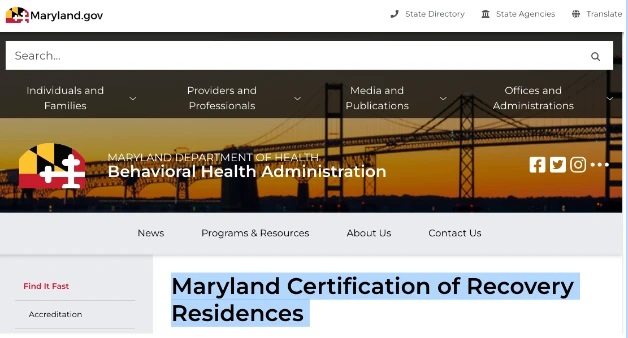
If you’re considering Maryland as your target location for your sober living home business, you’re in luck. The state makes it remarkably easy to open and operate sober living homes. The state’s certifying body has a straightforward application process, you can apply for certification online, and, even better, in many cases you don’t even need to apply for certification at all!
Because we know that sober living homes increase the success rate for addiction treatment exponentially, the state is also actively working to make it even easier to open sober living facilities in the near future. This is a state that recognizes the worth of sober living home businesses and is actively seeking your participation in the solution to the opioid crisis! We wish we could say the same for other states.
Today, we’ll cover the top four things that most people don’t realize about opening a sober living home in Maryland. Some of these items may surprise you, but they will all help you in developing your strategy and building the best sober living home business possible.
You Don’t Need to Get Certified or Licensed to Open a Sober Living Home in Maryland
While it is relatively easy to get your sober living home certified in the state of Maryland, it’s not always necessary.
Here’s the situations where you absolutely do need to get certified by the state in Maryland:
-
When your sober living home is accepting state funds
-
When you tell residents that you are a certified recovery residence
-
When you tell investors that you are a certified recovery residence
That’s it! So, if you are running a sober living facility that is exclusively self-pay and you refrain from posing as a “certified recovery residence” then you can completely ignore the state certification process. However, cities and counties may have their own group home, boarding home, or other local ordinances that impose additional requirements. You must verify all local regulations with your municipality and consult a qualified local attorney before beginning operations. If you want to work with lower-income residents who might be using state dollars (whether that’s through Medicaid or housing assistance) to cover rent, then you’re definitely looking at engagement with the certification process. If you’re seeking grants to help with startup or operating costs, you’re definitely going to need to get a “Certificate of Compliance” from the state of Maryland first.
The question of whether or not to get certified is really ultimately about your business model and your goals. It is possible, however, that the laws may change and Maryland may eventually require any and all sober living homes to get certified. There is a lot of legislative activity around sober living home regulation in general at present and it’s entirely possible the laws will change soon in Maryland, as well. In some cases where certification is not immediately sought, it may make sense to study up on the NARR standards used for certification just in case that comes to pass.
The State of Maryland Wants to See More Sober Living Homes, Not Less
Maryland is unique among states in that it does have an inter-agency coalition working to address addiction treatment policy. It’s even more unique in that this agency explicitly values sober living homes and recovery residences as a part of the solution to behavioral health at the state level. While this is common sense if you know the positive outcomes associated with sober living for residents, it is rare to see a state explicitly voice a positive opinion on sober living. This is a great indicator for sober living home operators that Maryland is a sober living home-friendly location for business.
The Laws Around Fire Codes and MAT for Sober Living Homes May Be Changing in Maryland
Speaking of changing laws, there’s good evidence that there will soon be changes made around “barriers to the expansion of recovery residences” in Maryland, which is great news for sober living home operators. Maryland’s Inter-Agency Opioid Coordination Plan, created by the Inter-Agency Opioid Coordinating Council, stipulates that reducing barriers to business for sober living home operators makes strategic sense in the battle against OUD in Maryland. Specifically, the report includes this segment on sober living:
** Recovery Residences Expansion:**Safe and secure housing is an important component for individuals in the early stages of recovery. Sadly, however, people seeking recovery housing are not always able to find it. The OOCC is committed to partnering with BHA and the Behavioral Health Advisory Council’s Recovery Residences Workgroup to identify barriers to the expansion of recovery residences, including regulations (such as fire codes) and medication assisted treatment (MAT) policies.
It seems logical, therefore, that we may expect to see some changes to the way the state of Maryland handles fire codes and MAT policies in relation to sober living. Exactly how this will work is debatable at present but it’s worth noting.
It’s Very Easy to Evaluate the Holes in the Marketplace for Maryland Sober Living Homes
Maryland maintains a list of all sober living homes in the state, as well as a companion list of all certified sober living facilities recorded by the Department of Mental Health. If you’re thinking of opening a sober living home in Maryland, you can leverage these lists to complete your analysis of the competition. Once you know what other organizations are doing, you can identify vulnerabilities in the market. Who is not currently served by the present marketplace? What areas are missing? What price point is underrepresented? What areas, price points and resident profiles are overrepresented by the current offerings? Tailor your business plan to the marketplace and you’ll reap the rewards.
More Sober Living App Blog Posts That May Interest Maryland Operators
Understanding National Regulations on Sober Living Homes in the United States - Part 2
Understanding National Regulations on Sober Living Homes in the United States - Part 1
Maryland NARR Affiliate Status
For information about certification standards and NARR guidelines in Maryland, see our guide on the Maryland NARR State Affiliate.
Need Help With Opening Your Sober Living Home or Recovery Residence in Maryland?
Sober Living App makes it easier - and more profitable - to operate sober living homes.
Our all-in-one app handles rent collection, admissions, property management, residents’ care coordination, community contacts, transportation details, calendars, staff, alumni and more - all from the convenience of your phone.
Claim your free trial today and see why more sober living homes prefer the Sober Living App.
Frequently Asked Questions
Do you need certification to open a sober living home in Maryland?
Not always. Certification is only required if you accept state funds, or represent yourself as a certified recovery residence to residents or investors. Self-pay homes that don't claim certification can operate without it.
Does Maryland support sober living home development?
Yes. Maryland's Inter-Agency Opioid Coordination Plan explicitly values sober living homes as part of the solution and is actively working to reduce barriers to recovery residence expansion in the state.
How can I research the sober living market in Maryland?
Maryland maintains public lists of all sober living homes and certified facilities through the Department of Mental Health. Use these to analyze competition, identify underserved areas, and find gaps in pricing or populations served.
Are fire codes and MAT policies changing for Maryland sober living homes?
Maryland's Inter-Agency Opioid Coordinating Council has identified fire codes and MAT policies as barriers to recovery residence expansion and is committed to addressing them, though specific changes are still pending.
What certification standards do Maryland sober living homes follow?
Maryland uses NARR (National Alliance for Recovery Residences) standards for its voluntary certification program. The state's certifying body offers a straightforward online application process.
Manage your homes more efficiently
From admissions to discharge, Sober Living App streamlines every aspect of running recovery residences.
Related Articles
Sober Living Home Business Plan Template: Complete Guide for 2026
Free sober living home business plan template with step-by-step instructions. Covers market analysis, financial projections, operations, licensing, and funding strategies for recovery residence startups.
How to Open a Sober Living Home in New Jersey: Complete 2026 Operator Guide
Start a sober living home in New Jersey: Class F license requirements, GSARR certification, P.L. 2025 c.60 regulations, startup costs by market, and opioid settlement funding. Step-by-step guide for operators.

Sober Living Resident Agreement Template [Free Download 2026]
Free sober living resident agreement template with customizable sections for house rules, rent, drug testing, and discharge policies. Copy-ready format.